Logo
Blog

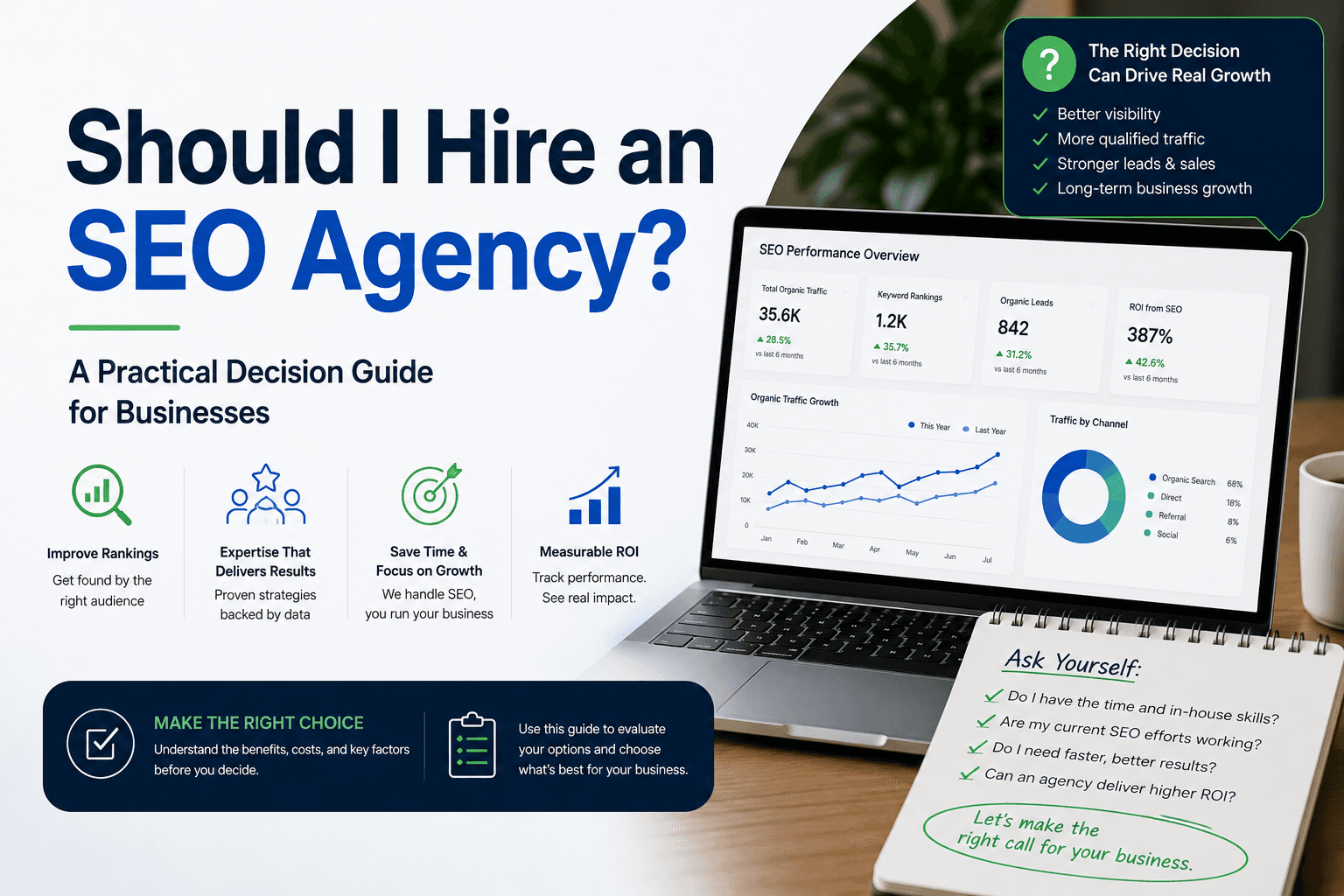
Should I Hire an SEO Agency?
A Practical Decision Guide for Businesses 2026

February 25, 2026
Should I Hire an SEO Agency? A Practical Decision Guide for Businesses 2026

Should I Hire an SEO Agency? A Practical Decision Guide for Businesses 2026

By The Development Agency February 25, 2026

If you are asking this question, something is not working.

  • Traffic feels unreliable.

  • Paid ads keep getting more expensive.

  • Sales are harder to grow than they used to be.

You are not looking for SEO theory. You are trying to decide whether bringing in an SEO agency is the right move, or whether it will turn into another sunk cost.

This guide is for ecommerce founders, business owners, and marketing leads who want a clear answer without sales pressure.

By the end, you will know whether hiring an SEO agency makes sense for your business right now, or whether fixing something else first will deliver better results.


Why So Many Businesses Ask This Question

This question rarely comes out of curiosity. It usually shows up when growth starts to feel harder than it should.

Paid ads getting expensive

Most businesses start with ads because they work fast.

  • Then costs creep up.

  • Clicks cost more.

  • Returns shrink.

  • Scaling means spending more, not earning more.

At some point, ads stop feeling like growth and start feeling like rent. That is often the moment businesses begin looking at SEO.


Traffic or sales have stalled

For many businesses, growth follows a pattern.

  • Early traction.

  • Then a plateau.

  • Then frustration.

Traffic levels off. Sales stop climbing. Competitors appear above you in search results. You start wondering whether organic growth is missing from your strategy.

SEO enters the conversation because it feels like the channel you never fully built.


Previous SEO attempts did not work

A large number of people asking this question have already tried SEO.

Maybe it was:

  • A freelancer

  • A low-cost provider

  • An agency focused on reports, not outcomes

They paid. Rankings moved a little. Revenue did not.

Now the hesitation is real. The question is no longer “should I do SEO” but “should I trust anyone with this again”.


Pressure to grow without wasting budget

Budgets are tighter. Expectations are higher.

  • Founders want growth.

  • Marketing teams need accountability.

  • No one wants another long-term expense that does not move the needle.

This question often appears when leadership wants a smarter growth lever, not another experiment.


What Problem Are You Actually Trying to Solve?

Before deciding whether to hire an SEO agency, it helps to be honest about the real issue.

SEO is not a fix for everything.

Not enough traffic

Some businesses simply are not visible.

They have solid products and decent conversion rates, but not enough people are finding them. In this case, the problem is demand capture. SEO often fits here.


Traffic without sales

Other businesses get traffic, but it does not convert.

This points to problems like:

  • Weak intent targeting

  • Poor page structure

  • Messaging gaps

  • Trust issues

Hiring an SEO agency without fixing conversion issues first rarely helps. Traffic alone does not pay bills.


Too much reliance on ads

If paid media is the only growth engine, risk builds quietly.

Costs rise. Performance fluctuates. One platform change can shake revenue.

SEO becomes attractive here as a stabiliser, not a replacement. Businesses in this position usually want balance and long-term leverage.


Unclear growth direction

Some businesses feel stuck because nothing is clearly broken, but nothing is clearly working either.

SEO gets considered as a way to create momentum, structure, and a long-term plan. In these cases, the value of an agency is often strategic clarity rather than quick wins.


Key takeaway before you move on

Hiring an SEO agency is not a decision about SEO.

It is a decision about:

  • how you want to grow

  • how much risk you can tolerate

  • how patient you can be

  • and whether your foundations support organic growth

The next sections should help you answer that honestly, without guesswork.


Your Three Real Options (Not Just Hiring an Agency)

When people ask “should I hire an SEO agency”, they are usually choosing between three paths. Each comes with trade-offs that affect cost, speed, and results.

Option 1: Do SEO yourself

Many founders and small teams start here.

Why people choose it

  • No agency cost

  • Full control

  • Learn SEO internally

What usually happens

  • SEO competes with everything else on your plate

  • Learning curves slow progress

  • Execution stays inconsistent

  • Strategy becomes reactive, not planned

DIY SEO works when:

  • The site is small

  • Growth expectations are modest

  • Time matters more than speed

It struggles once competition increases or revenue pressure rises.


Option 2: Hire an in-house SEO

This sits between DIY and an agency. 

Why people choose it

  • Dedicated focus

  • Deep business knowledge

  • Faster internal alignment

Hidden challenges

  • Salary plus tools often cost more than an agency

  • One person rarely covers technical, content, links, and analytics well

  • Strategy depends heavily on one hire

In-house SEO works best for larger teams with:

  • Strong development support

  • Content resources

  • Clear leadership direction


Option 3: Hire an SEO agency

Agencies exist to compress time and reduce trial and error.

Why businesses choose agencies

  • Access to multiple specialists

  • Proven systems and processes

  • Faster diagnosis of issues

  • Experience across industries and sites

The risk

  • Poor agencies sell tasks, not outcomes

  • Misalignment leads to wasted months

Agencies work best when the business is ready to act on recommendations, not just receive reports.


Quick comparison: which option fits where?

Factor

Do SEO Yourself

In-house SEO

SEO Agency

Upfront cost

Low

Medium to high

Medium

Speed to results

Slow

Medium

Faster

Skill coverage

Limited

Partial

Broad

Strategic depth

Low

Medium

High

Scalability

Low

Medium

High

Risk of mistakes

High

Medium

Lower

This table highlights one thing clearly. The decision is not about SEO knowledge. It is about speed, risk, and scale.


When Hiring an SEO Agency Makes Sense

Hiring a seo agency works when certain conditions are already in place.

You already have product-market fit

SEO amplifies demand. It does not create it.

If customers already buy your product or service and return for more, SEO helps you reach more of the right people. Without product-market fit, traffic growth rarely translates into sustainable revenue.


You need strategy, not tasks

Many businesses do not need:

  • more blog posts

  • more keywords

  • more reports

They need clarity.

A good SEO agency focuses on what to fix first, what to ignore, and how each action supports business goals. Strategy matters more than volume of work.


Your site has technical or structural limits

Common blockers include:

  • poor site architecture

  • slow performance

  • crawl issues

  • weak internal linking

  • duplicate content from platforms or filters

These problems restrict growth even when content exists. Agencies that specialise in SEO identify and resolve these blockers faster than most internal teams..


You want scalable growth, not short wins

SEO rewards patience.

Independent ecommerce benchmarks show that organic search is one of the largest and most consistent drivers of revenue over time, with performance that compounds as visibility grows rather than resetting each month like paid advertising. (Source: Wolfgang Digital KPI Report, Google Think With Google)

If the goal is sustainable growth rather than quick spikes, agency-led SEO fits better.


When You Should Not Hire an SEO Agency Yet

In some cases, hiring an SEO agency too early causes frustration and wasted spend.

Your conversion rate is broken

If visitors are not converting into leads or sales, more traffic will not fix the problem.

Issues with messaging, usability, trust, or pricing should be addressed before investing heavily in SEO.


Tracking and data are unreliable

SEO performance depends on accurate data.

If analytics, goals, or ecommerce tracking are incorrect, it becomes impossible to measure real impact. Fix tracking first to avoid confusion later.


Margins are too thin for delayed returns

SEO takes time to deliver results.

If the business cannot support a few months of investment before seeing returns, pressure builds quickly. In these cases, short-term channels may be more suitable until margins improve.


You expect instant results

SEO is not immediate.

Businesses expecting fast wins often leave just as progress begins. SEO works best for those prepared to invest consistently and allow momentum to build.


What a Good SEO Agency Actually Does

Not all SEO agencies work the same way. The difference between good and bad SEO usually shows up in how decisions are made and how success is measured.

Owns strategy and prioritisation

A good SEO agency does not start with tactics.

It starts with a plan.

That means deciding:

  • which pages matter most

  • which problems block growth

  • what to fix first

  • what can wait

SEO involves hundreds of possible tasks. Strategy is the process of choosing the few that actually move revenue. Without prioritisation, effort gets spread thin and results stall.


Fixes technical blockers first

Technical issues quietly limit performance.

Common examples include:

  • poor crawlability

  • slow page speed

  • duplicate URLs

  • broken internal linking

  • indexing issues from filters or parameters

A good agency audits these early and fixes them before pushing content or links. Traffic growth without technical foundations rarely lasts.


Aligns content with buyer intent

Good SEO content is not written for keywords alone.

It matches how people search and why they search.

That includes:

  • informational content for research

  • comparison content for evaluation

  • category pages for buying intent

  • product pages that answer objections

Agencies that focus only on blog volume miss the commercial side of SEO. Intent alignment is what turns traffic into revenue.


Reports on revenue impact, not rankings

Rankings are signals, not outcomes.

A good SEO agency tracks:

  • qualified traffic

  • conversions

  • assisted revenue

  • changes in acquisition cost

  • contribution to sales pipeline

Reporting focuses on business impact, not just keyword movement. Rankings matter only when they lead to measurable growth.


How to Tell a Good SEO Agency From a Bad One

The hiring stage determines success more than any tactic.

Questions you should ask before hiring

Ask questions that reveal thinking, not promises:

  • What would you prioritise in the first 90 days?

  • How do you decide what to work on first?

  • How do you measure success beyond traffic?

  • What input do you need from our team?

  • How do you handle changes after Google updates?

Clear answers signal experience. Vague answers signal risk.


Red flags to watch out for

Be cautious if an agency:

  • guarantees rankings

  • avoids talking about revenue

  • focuses heavily on reports but lightly on action

  • cannot explain why tasks matter

  • locks you into long contracts without clear milestones

SEO involves uncertainty. Honest agencies explain risks instead of hiding them.


What real deliverables look like

Strong deliverables are not just documents.

They include:

  • clear technical fixes with implementation guidance

  • content plans tied to search intent

  • prioritised roadmaps

  • regular insight-driven updates

  • explanations that connect work to outcomes

The goal is progress, not paperwork.


SEO Agency Cost, Timelines, and ROI (What to Expect)

Understanding cost and timing helps set realistic expectations.

What drives SEO pricing

SEO pricing varies based on:

  • site size and complexity

  • competition level

  • technical debt

  • content needs

  • growth goals

Lower prices often mean limited scope or generic work. Higher prices reflect deeper strategy, execution, and accountability.


Typical timelines by business type

SEO timelines differ by situation.

Business type

Early traction

Strong impact

Local services

2–4 months

4–8 months

Established ecommerce

3–6 months

6–12 months

New ecommerce site

4–6 months

9–12 months

Competitive B2B

4–6 months

9–15 months

Results build gradually. Momentum compounds once foundations are in place.


How SEO ROI usually shows up

SEO returns rarely appear as one sudden jump.

They show up as:

  • steady traffic growth

  • higher quality leads

  • lower reliance on ads

  • improved conversion rates from intent-matched pages

  • stronger brand visibility in search

Over time, SEO reduces acquisition costs and supports more predictable growth.


Quick Decision Checklist: Should You Hire an SEO Agency?

This checklist helps you make the call without guesswork.

You are likely ready if…

  • Your product or service already sells without heavy discounting

  • You know who your ideal customer is

  • Your website converts at a reasonable level

  • Paid ads work but feel expensive or unstable

  • You want predictable, long-term growth

  • Your team can act on recommendations

  • You are prepared to invest for several months, not weeks

If most of these feel true, an SEO agency is likely a good fit.


You should wait if…

  • Visitors reach your site but rarely convert

  • Analytics or ecommerce tracking is inaccurate

  • You are unsure what your main offer really is

  • Margins are too tight to allow a ramp-up period

  • You expect fast wins or guaranteed rankings

  • No one internally can support changes or approvals

In this case, fixing foundations first leads to better results later.


Final Take: Make the Decision With Clarity, Not Pressure

Hiring an SEO agency should feel deliberate, not rushed.

SEO works best when it supports a business that already knows what it sells, who it serves, and where growth should come from. When those pieces are in place, SEO compounds. When they are missing, SEO exposes gaps.

The right decision depends on readiness, not urgency.


What to do next if the answer is yes

If you decide to move forward:

  • Look for an agency that talks about revenue, not vanity metrics

  • Ask how they prioritise work in the first 90 days

  • Expect clear explanations, not jargon

  • Choose transparency over promises

If you want a reference point for how ecommerce-focused SEO is approached in practice, you can review how we work here: ecommerce seo agency
No obligation. Just clarity.


What to fix first if the answer is no

If now is not the right time:

  • Improve conversion rate and messaging

  • Fix analytics and goal tracking

  • Clarify your core offer and audience

  • Reduce reliance on a single channel

These changes strengthen any future SEO investment.

When you are ready, SEO becomes a growth lever rather than a risk.

If you want a second opinion or help prioritising next steps, a short conversation often brings clarity faster than more research:
Contact Us


Bottom line

If you reached this point, you should already feel clearer than when you started.

The real question was never “should I hire an SEO agency”.
The real question was whether SEO fits your business right now, given your goals, resources, and expectations.

If your business has a proven offer, a website that converts, and a desire for steady, long-term growth, working with the right SEO agency can become one of your strongest growth investments. When done properly, SEO builds visibility, reduces reliance on paid ads, and compounds over time.

If some foundations are missing, waiting is not a failure. It is often the smarter move. Fixing conversion issues, tracking, or positioning first makes every future SEO dollar work harder.

By now, you should be able to answer this question honestly for your own situation.
If you can, this guide has done its job.

If there are still uncertainties, edge cases, or specific challenges you want to sanity-check, a short conversation often brings more clarity than another article.

You can reach us here if you want an objective, no-pressure discussion about your next step.

Whether you move forward now or later, making the decision with clarity is what leads to better outcomes. Hence, a  good SEO agency does not pressure you into a decision. It helps you make the right one at the right time. That mindset matters more than tactics.


Frequently Asked Questions

Latest Blogs

Should I Hire an SEO Agency? A Practical Decision Guide for Businesses 2026

February 25, 2026

Should I Hire an SEO Agency? A Practical Decision Guide for Businesses 2026

Unsure whether to hire an SEO agency? Learn when it makes sense, when to wait, costs, timelines, and how to decide with confidence.

How AI Automation is Transforming Businesses in 2025

July 16, 2025

How AI Automation is Transforming Businesses in 2025

AI automation is reshaping how businesses work. Learn key ways AI is transforming businesses, industry-specific impacts, and how to prepare your business for the future.

What is AI Automation? How It's Shaping the Future of Work

July 15, 2025

What is AI Automation? How It's Shaping the Future of Work

Understanding AI automation is key to staying competitive. Learn what AI automation is, how it differs from regular automation, real-world examples, and challenges.

What Are Website Wireframes & Why They Matter in Web Design

July 12, 2025

What Are Website Wireframes & Why They Matter in Web Design

Website wireframes are essential for successful web development. Discover what wireframes are, why they're important, common mistakes, and best practices.

What is Email Marketing? Reasons It Still Works in 2025

May 28, 2025

What is Email Marketing? Reasons It Still Works in 2025

Email marketing remains one of the most effective digital channels. Explore why email still works, automation strategies, best practices, and ROI benchmarks.

AI & Automation Trends: What Businesses Need to Know

January 31, 2025

AI & Automation Trends: What Businesses Need to Know

AI and automation are reshaping industries. Understand the differences between AI and traditional automation, key benefits, implementation strategies, and trends.

Proven Digital Marketing Strategies for Growth & SEO

January 31, 2025

Proven Digital Marketing Strategies for Growth & SEO

Digital marketing is essential for Australian businesses. Learn proven strategies for SEO, PPC, social media, email marketing, and lead generation.

Ready to Grow Your Revenue?

Partner with an Australian digital marketing agency that cares about your bottom line.