Ecommerce Product Page SEO: How to Rank Product Pages and Convert Visitors
Product pages are where the money is.
A search for "Brooks Ghost 16 Men's Size 11" is not research - it is a transaction waiting to happen. The customer has already decided what they want. They are deciding where to buy it. Your product page either closes that sale or sends them to a competitor.
Yet most eCommerce stores optimise product pages for rankings or conversions — rarely both. That is the fundamental mistake. In 2026, Google uses engagement signals as a direct ranking factor. A page that ranks but nobody buys will eventually lose that ranking to a page that does both. SEO and CRO are not competing priorities on product pages. They are the same discipline viewed from two angles.
This guide gives you the unified framework for building product pages that rank and convert simultaneously.
Key Highlights
- Product pages target high-intent, conversion-ready keywords
- SEO and CRO must work together for product page success
- Product titles impact both rankings and click-through rate
- Unique product descriptions improve rankings and avoid duplication
- Schema markup improves visibility in search results and AI Overviews
- Images play a key role in both SEO and user experience
- Internal linking supports product page rankings
- User-generated content increases trust and conversions
- Technical SEO ensures product pages are indexed properly
- Small optimisation changes can significantly improve conversions
What Is Ecommerce Product Page SEO?
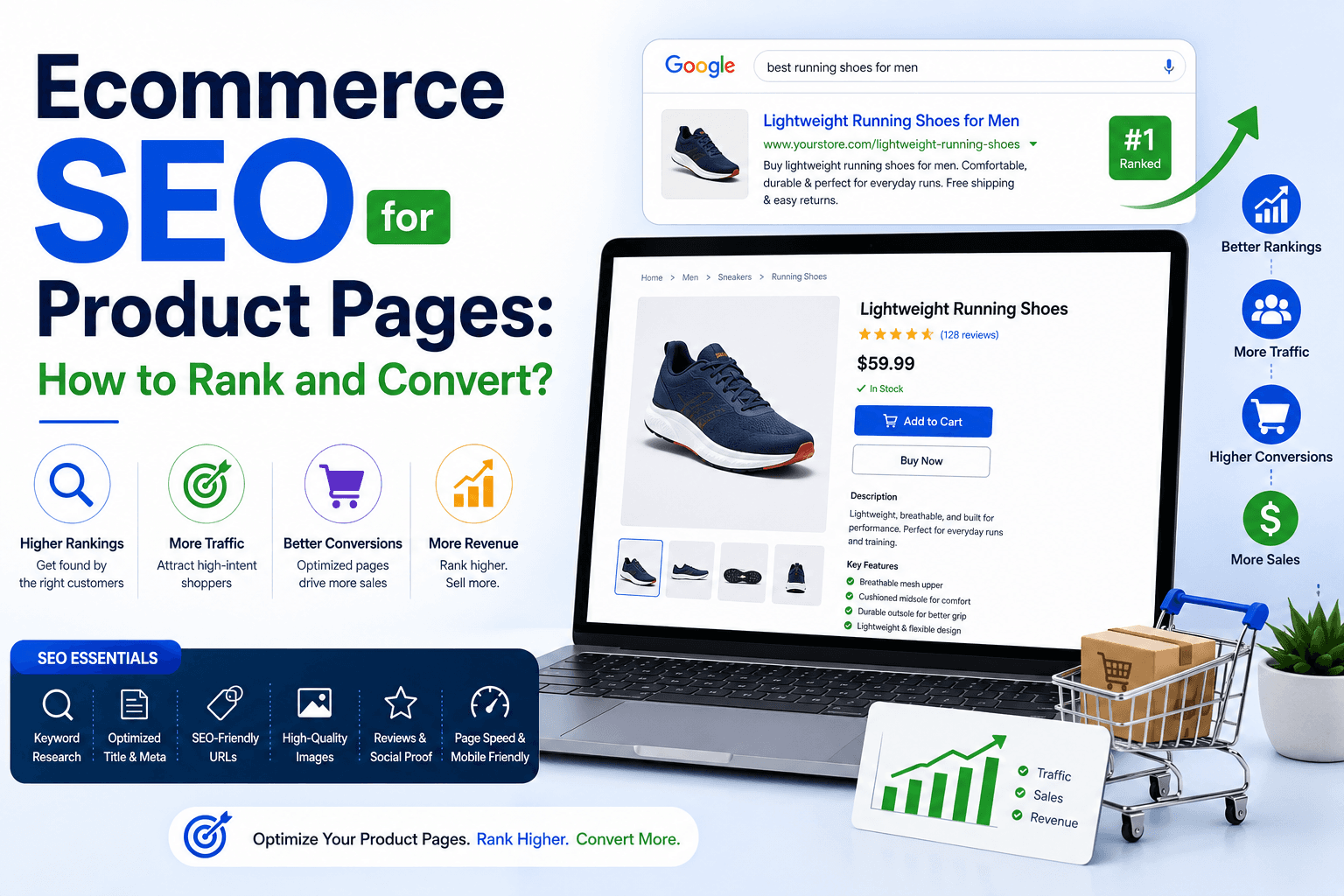
Ecommerce product page SEO is the process of optimising individual product pages to rank for high-intent keywords and convert visitors into customers.
It combines technical optimisation (schema, speed, indexability), on-page content (titles, descriptions, images), and conversion design (trust signals, CTAs, reviews) into a single revenue-focused discipline. In 2026, these cannot be separated — Google measures engagement quality as a ranking signal, meaning a page's ability to convert visitors directly affects its ability to maintain rankings.
The Product Page Optimisation Framework
We do not separate SEO and CRO. Every optimisation decision is evaluated for its impact on both rankings and revenue simultaneously.
1. Title and Meta — The Click Magnet
The product title is the single most important SEO element on a product page. It appears in the H1, the browser tab, and drives meta title generation. It is also the first thing a potential customer reads in search results — making it both a ranking signal and a conversion trigger.
The formula:
[Brand] + [Product Name] + [Key Feature] + [Differentiator or Variant] |
Generic Title | Optimised Title |
Running Shoe - Blue | Brooks Ghost 16 Men's Road Running Shoe — Cushioned, Neutral, Wide Fit Available |
Protein Powder 1kg | Optimum Nutrition Gold Standard Whey 1kg — Chocolate Fudge, 30 Servings |
Coffee Grinder | Breville Smart Grinder Pro — 60 Grind Settings, Espresso to Plunger |
The optimised title achieves three things simultaneously: it ranks for brand and model searches (highest intent), feature-based searches (broader reach), and use-case searches (earlier funnel capture). The specificity also improves click-through rate because it immediately confirms the searcher found exactly what they were looking for.
Meta description strategy: Write for the customer, not Google. Google does not click — customers do. Include the primary benefit, a shipping or offer hook, and a soft CTA under 155 characters.
Lightweight, cushioned, neutral. Built for everyday road running. Free AU shipping on orders over $99. In stock. Ships same day. |
2. Unique Descriptions — The Differentiator
Manufacturer descriptions are a duplicate content trap. When 500 stores use identical copy, Google selects the highest-authority domain — usually the manufacturer — and suppresses the rest. A store using manufacturer copy verbatim is competing against the manufacturer with their own content. It loses every time.
The four-layer description framework:
- What it is — keyword-rich, clear identification
- Who it is for — intent matching for the target buyer
- Why it is better — specific differentiator from alternatives
- What to expect — sizing, fit, delivery, returns confidence
The tiered approach for large catalogues:
Tier | Products | Approach |
Tier 1 | Top 100 revenue products | 100% unique, 300+ words, benefit-led |
Tier 2 | Next 200–500 products | Unique opening and closing paragraphs, templated specs in between |
Tier 3 | Long-tail / low-traffic products | Template-based with unique key variables: size, colour, material |
Quality matters more than volume. One hundred and fifty words of genuinely unique, benefit-led content outperforms five hundred words of padded manufacturer copy — for both rankings and conversions.
3. Technical and Schema — The AI Bridge
In 2026, schema markup is not a nice-to-have. It is the API that connects your product pages to Google's AI Overviews, product carousels, and rich snippet features. If your schema is incomplete, your products do not appear in AI-generated shopping results — regardless of how well the page ranks organically.
Mandatory schema fields:
Fields required for Google's AI shopping features: `name`, `price`, `priceCurrency`, `availability`, `shippingDetails`, and `hasMerchantReturnPolicy`. Missing any of these reduces eligibility for rich results and AI carousels.
**The Merchant Center Sync Rule:** Schema on your product pages must match your Google Merchant Center feed exactly. If your schema says "In Stock" but your feed says "Out of Stock," Google cross-references these signals and suppresses organic rankings within 48 hours. This is one of the most common hidden ranking killers for stores running both organic and Shopping campaigns.
**INP — the silent conversion killer:** The Add to Cart button is the most performance-critical element on any product page. INP (Interaction to Next Paint) must be under 200ms. If a heavy review widget or third-party chat script delays the button response, users double-click — creating duplicate cart entries and checkout errors. Stores with INP above 300ms see 15–25% higher cart abandonment than those under 200ms. Test INP specifically on product pages using Chrome DevTools and Google Search Console's Core Web Vitals report.
4. Image Optimisation — SEO and UX Combined
Product images are the primary decision-making tool for online shoppers and a direct LCP (Largest Contentful Paint) signal for Google. They require optimisation on both dimensions simultaneously.
Technical requirements:
- Format: Serve AVIF first — 20% better compression than WebP with identical visual quality, making it the 2026 gold standard for mobile-heavy eCommerce. Fall back to WebP, then JPEG for legacy browsers, using the `<picture>` element
- File size: Hero product images under 100KB. Supporting images under 60KB
- Dimensions: Set explicit `width` and `height` on every image to prevent Cumulative Layout Shift (CLS)
- Lazy loading: Apply `loading="lazy"` to all product images below the fold. Do NOT lazy load the hero image — delaying the main product image directly kills your LCP score
Alt text formula:
[Brand] [Product Name] [Variant] — [View/Angle]
Example: `Brooks Ghost 16 Men's Road Running Shoe — Navy, Side Profile`
5. Reviews and UGC — Social Proof Engine
Reviews serve a dual purpose: they are the most powerful trust signal for purchase decisions and a rich source of long-tail keyword content that Google can index.
Review best practices:
- Display a minimum of 10 reviews on product pages to establish credibility. Products with fewer than 3 reviews see 270% lower conversion rates than those with 10+.
- Enable photo reviews — customer-uploaded images appear in Google image search and increase conversion rates by 65% versus text-only reviews.
- Respond to all reviews, positive and negative. This signals active customer engagement to Google and demonstrates brand responsiveness to searchers reading reviews in SERPs.
- Leverage review keywords: customers use different language than manufacturers. A review saying "great for marathon training" captures "marathon running shoes" searches that the product title never could.
6. Internal Linking — Authority Distribution
Product pages rarely earn links naturally — they are transactional, not content-rich. Without internal links from high-authority pages, product pages depend entirely on their own authority, which is often insufficient to rank for competitive terms.
Priority internal link sources for product pages:
- Category pages — the primary authority source for products within that category. Link products from at least 2 subcategory pages.
- Blog content — contextual links from relevant articles (gift guides, use-case posts, comparison posts). These pass contextual relevance signals that category links cannot.
- Related products — cross-links between related SKUs distribute authority across the catalogue and increase average order value.
Measuring Success: Product Page KPIs
SEO and CRO convergence means measuring both rankings and revenue together.
SEO Metrics | Conversion Metrics |
Keyword rankings for product terms | Add-to-cart rate |
Organic click-through rate (CTR) | Product page conversion rate |
Rich snippet appearance rate | Average order value (AOV) |
Product schema coverage % | Cart abandonment rate |
Core Web Vitals pass rate | Review submission rate |
Product Page Checklist
- Product title: brand + name + key feature + differentiator
- Meta title and description optimised for click-through
- 100% unique product description, minimum 150 words
- Complete Product schema with all required fields
- Hero image: AVIF/WebP, under 100KB, no lazy loading
- Alt text on every image using brand-name-variant-angle formula
- Explicit width and height attributes on all images
- Minimum 10 customer reviews displayed
- Add to Cart button above fold on mobile
- Shipping timeframes and returns policy clearly visible near CTA
- Trust signals (security badges, ABN, contact details) present
Get a Free Product Page Audit If your product pages are ranking but not converting — or getting impressions but not clicks — we can identify exactly what is blocking your revenue. Contact The Development for a free 30-minute product page audit. We work with Australian eCommerce stores generating $500K to $50M+ annually.
For stores building a complete organic growth system, our eCommerce SEO strategy guide explains how product page SEO fits into a revenue-focused framework. For technical issues blocking product page rankings, our eCommerce SEO audit process covers how to find and prioritise fixes by revenue impact. Explore our eCommerce development services to see how The Development builds product pages optimised for rankings and conversions from the ground up.