What "NDIS in motion" Actually Covers
The NDIS in motion – April 2026 edition (published by Gilbert + Tobin) is a sector update newsletter covering recent announcements, reminders, and regulatory updates.
The April 2026 edition specifically covered:
- ✓NDIS Amendment (Integrity and Safeguarding) Bill 2026 — passed 1 April 2026
- ✓ACCC observations on consumer issues in the NDIS market
- ✓Mandatory registration timetable for SIL and platform providers (1 July 2026)
- ✓Federal Court decision on "reasonable and necessary supports" funding criteria
Crucially, "NDIS in motion" does NOT publish specific website/digital technical standards. The digital requirements flow from the broader NDIS Practice Standards, Disability Discrimination Act, and Privacy Act 1988 which auditors now enforce through continuous compliance monitoring rather than periodic audits.
The 2026 Digital Compliance Framework for NDIS Providers
Website as Compliance Evidence Trail
The NDIS Commission has shifted from periodic audits to continuous compliance monitoring. Your website is now part of the evidence trail auditors review at any time.
What auditors check on your digital presence:
- ✓Whether your public-facing information matches your internal operations
- ✓If your website reflects current registration status and services
- ✓Whether complaints processes are accessible online
- ✓If privacy policies are current and accurate
Platform Provider Registration (1 July 2026)
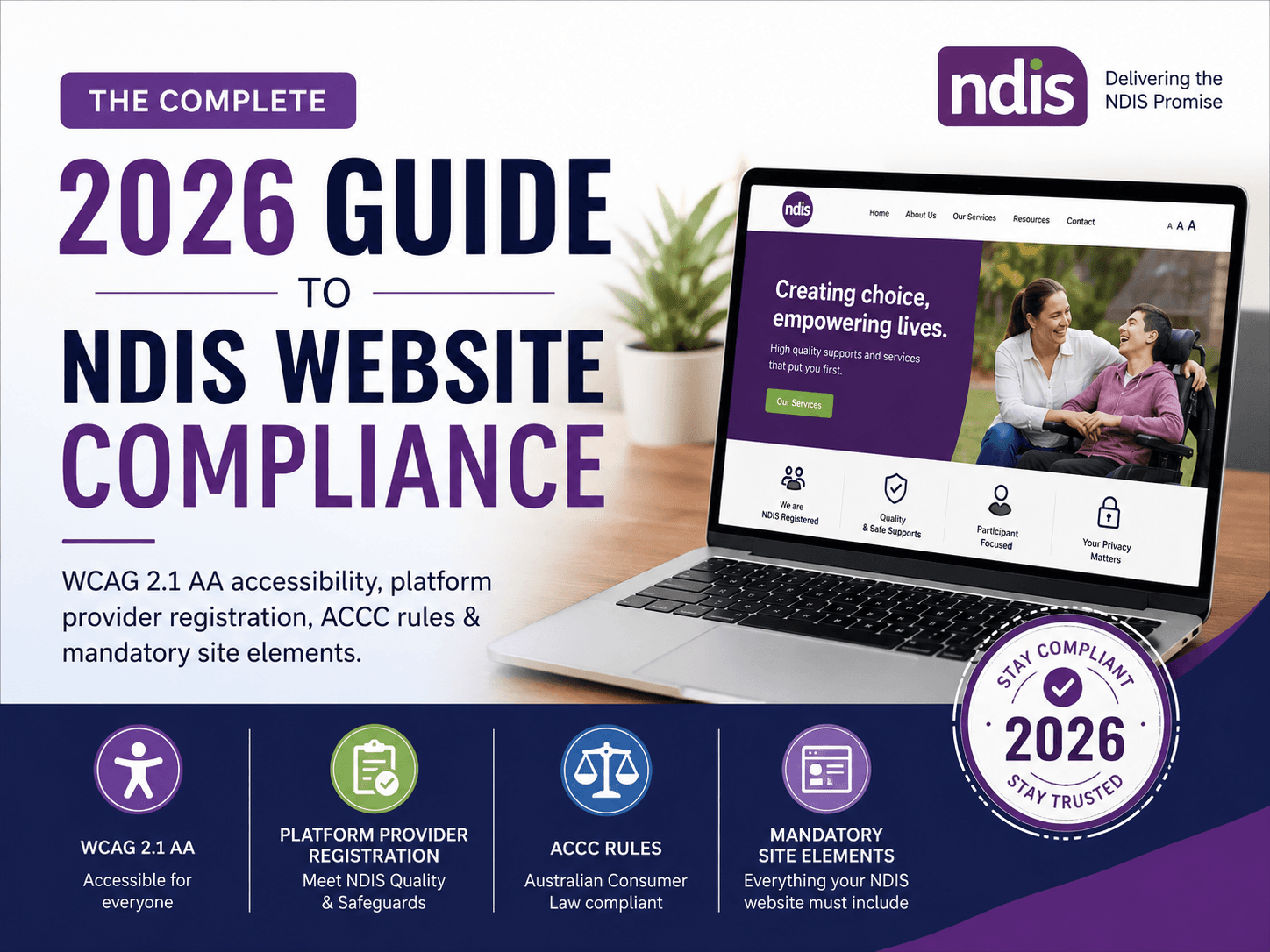
This is the biggest digital-specific requirement for 2026. From 1 July 2026, platform providers (like seekcarer.com.au) MUST register with the NDIS Commission.
Definition of "Platform Provider"
"An NDIS provider that uses a profile-based platform to connect participants with workers to deliver NDIS supports, for example an app or website where participants and workers create a 'profile'... and that collects NDIS-funded payments as part of its operations."
Registration requirements for platform providers include:
- ✓Independent audits against NDIS Practice Standards
- ✓Worker screening checks
- ✓Suitability assessments
- ✓Complaints and incident management systems
- ✓Notification requirements
- ✓Clear definition of service relationships (who is responsible for what)
WCAG 2.1 AA Accessibility
While not explicitly legislated by the NDIS Commission, WCAG 2.1 AA is the accepted benchmark and aligns with obligations under the Disability Discrimination Act.
Specific requirements:
- ✓Keyboard navigation works throughout the site
- ✓Screen readers can interpret all content
- ✓Sufficient colour contrast (4.5:1 for normal text)
- ✓All images have meaningful alt text
- ✓Forms are correctly labelled
- ✓Videos have captions
- ✓Mobile responsiveness (most participants browse on phones)
- ✓Plain language — no jargon, short sentences
Specific Website Elements
Based on NDIS Practice Standards and auditor expectations, every provider website MUST include:
| Element | Requirement | Why It Matters |
| NDIS Registration Number | Display on homepage/footer | Transparency signal; auditors cross-check |
| Clear Provider Identification | Business name, ABN, service areas | Cross-matched with registration documents |
| Detailed Service Information | Each service on its own page, plain language | Prevents "marketing fluff" non-conformity |
| Participant Rights & Responsibilities | Dignity, choice, autonomy, privacy | NDIS Practice Standards requirement |
| Accessible Complaints Form | Online, mobile-friendly, easy to find | Auditors actively check this; PDF-only is a risk |
| Incident Management Statement | How incidents are identified, managed, reported | Required for registration |
| Privacy Policy | Current, reflects actual data practices | Privacy Act 1988; outdated = non-conformity |
| Accurate Service Representation | Only list services you're registered for | Discrepancies = compliance issues |
Electronic Payments System (2026 Bill)
The NDIS Amendment (Integrity and Safeguarding) Bill 2026 introduces a new electronic payments system requiring providers to lodge payment claims through NDIA's online systems and digital channels.
Impact on platform providers:
- ✓All claims must flow through NDIA online systems (no more off-system claims)
- ✓Payments subject to risk detection systems
- ✓The NDIA will have direct line of sight over where money is going
- ✓Minister Butler stated the goal is 90% of NDIS payments through registered providers
ACCC Digital Marketing Compliance
The ACCC is actively enforcing Australian Consumer Law against NDIS providers for digital marketing violations:
- !False/misleading claims: Terms like "NDIS approved," "NDIS-registered product," "NDIS permitted" are breaches
- !Unfair contract terms: Standard form contracts under scrutiny
- !Charging for services not supplied: Digital billing records must match actual delivery