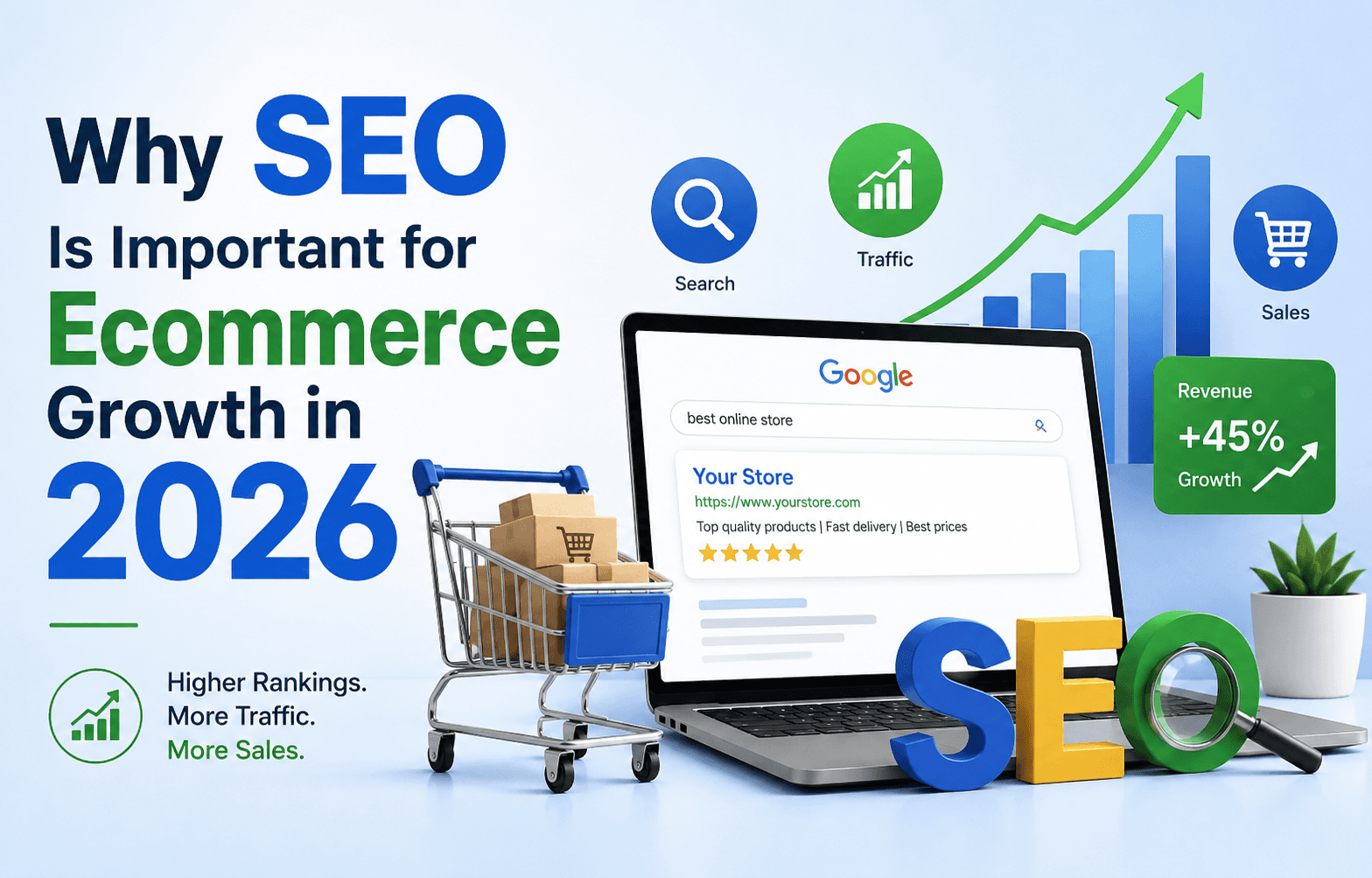
Ecommerce SEO Best Practices: The 2026 Checklist for High Growth Stores
Most eCommerce SEO advice is fragmented.
One article explains technical SEO. Another explains product page optimization. Another talks about backlinks. You collect tactics from 12 different sources and still have no clear system.
But eCommerce growth requires structured SEO, not random tactics. You need a framework that covers technical foundations, category optimization, product SEO, content strategy, and conversion improvements simultaneously.
This guide provides the complete eCommerce SEO checklist for 2026. Not theory. Not basics. The exact practices that separate stores generating $50,000 monthly organic revenue from those stuck at $5,000.
Key Highlights: What You'll Learn
- INP Under 200ms - The critical 2026 metric that replaced FID, why third-party scripts kill it
- Faceted Navigation - The "silent killer" with 47,000 page disaster example
- Product Schema for AI - Now feeds AI Overviews, not just star ratings
- Merchant Center Feed Sync - Must match page prices exactly or rankings get suppressed
- Category Pages 60-80% Revenue - Why they're traffic engines vs product pages
- Content Placement Strategy - 1-2 sentences above grid, 300-500 words below
- Unique Descriptions - Tiered approach for scale (top 100, next 200, long-tail)
- E-E-A-T Signals - Proof you're not an AI-generated dropshipping site
- Priority Roadmap - What to fix first, realistic timelines
- Real ROI Examples - $144K from one category, $13K from CRO, $18K from one guide
What Is Ecommerce SEO?
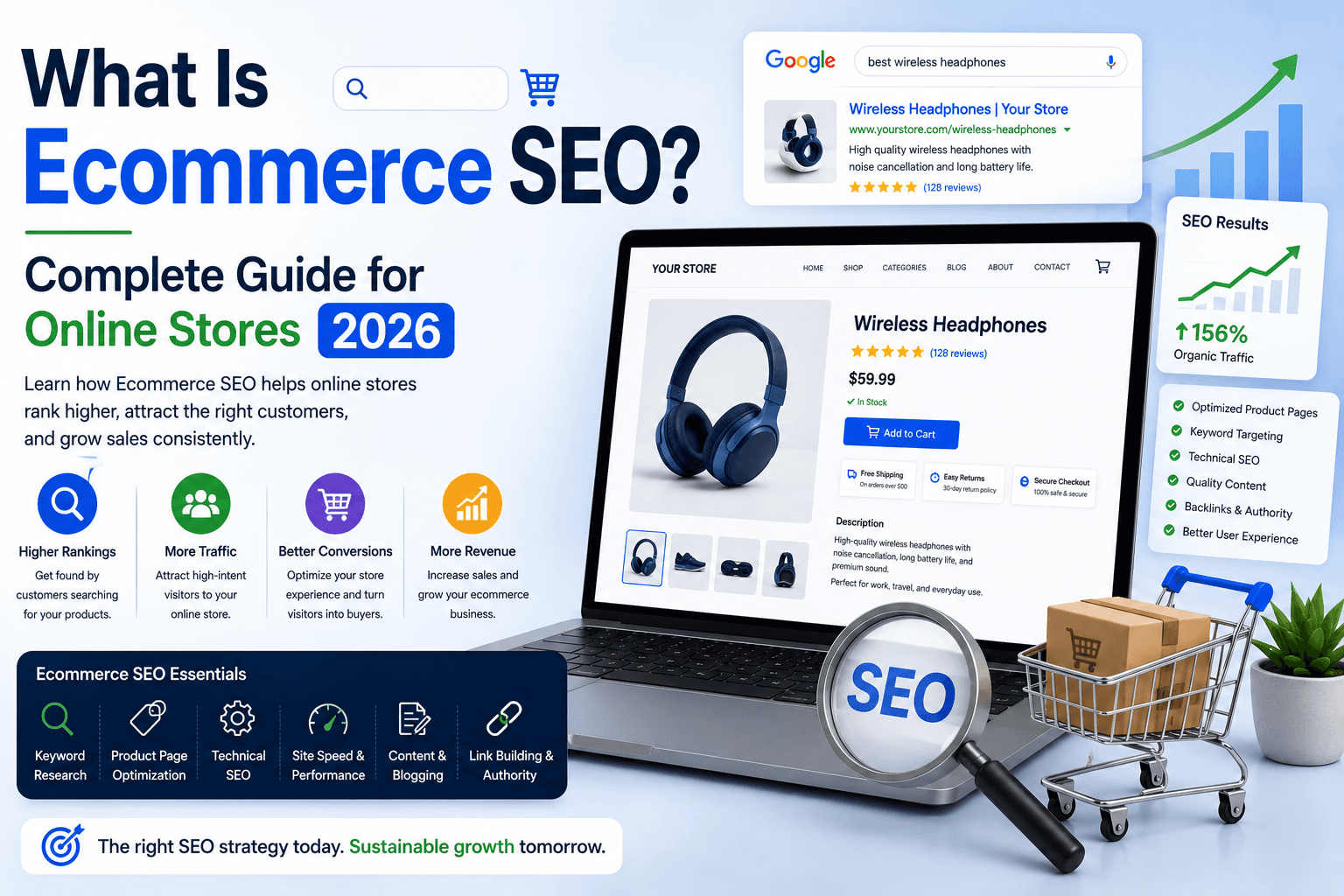
Ecommerce SEO is the process of optimizing online stores to rank higher in search engines for product, category, and informational queries that drive revenue.
Unlike traditional website SEO, eCommerce SEO is uniquely complex because:
- Stores have hundreds or thousands of pages (vs. 10-50 for service businesses)
- Product and category pages require different optimization approaches
- Duplicate content issues emerge from variants, filters, and similar products
- Technical SEO directly impacts revenue (slow checkout = lost sales)
- Conversion rate matters as much as rankings
The four types of eCommerce SEO:
Product SEO: Optimizing individual product pages for long-tail searches like "waterproof hiking boots size 10 mens"
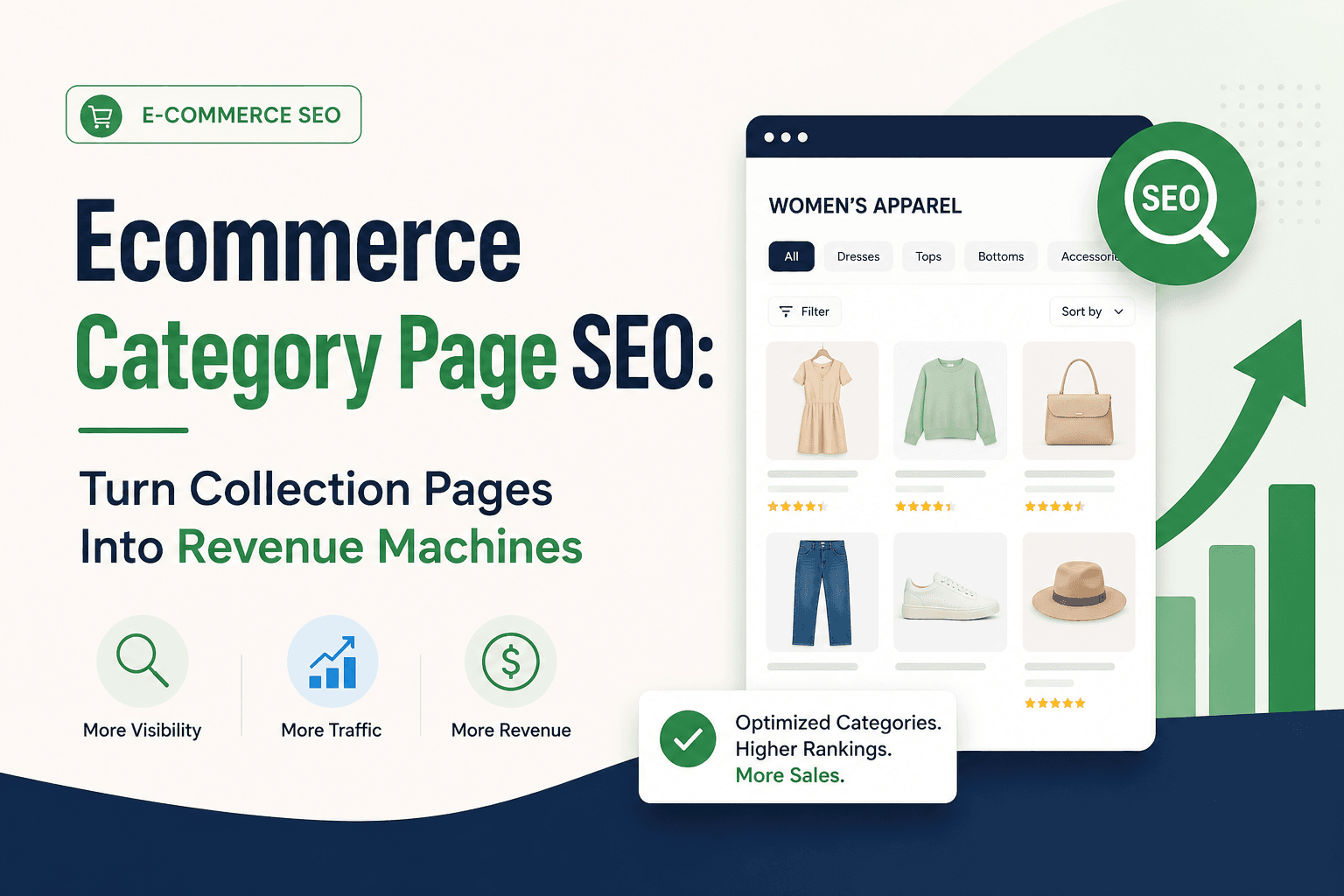
Category SEO: Optimizing category pages for broader searches like "mens hiking boots" or "waterproof boots"
Technical SEO: Ensuring search engines can crawl, index, and rank your store efficiently despite large product catalogs
Content SEO: Creating informational content (guides, comparisons, tutorials) that attracts high-intent buyers before they search for specific products
All four types work together. Category pages drive high-volume traffic. Product pages convert long-tail searches. Technical SEO enables both. Content SEO builds authority and captures early-stage buyers.
For stores struggling with fundamentals, our technical SEO for eCommerce guide explains which technical issues block rankings most.
Why Ecommerce SEO Is More Complex Than Traditional SEO
Challenge 1: Scale
Service businesses optimize 20 to 50 pages. eCommerce stores optimize 500 to 50,000 pages. Manual optimization becomes impossible.
Challenge 2: Duplicate content
Similar products, color variants, size variants, filtered category pages, and sorted views create thousands of near-duplicate pages competing against each other.
Challenge 3: Category hierarchy
Search engines must understand that "Women's Running Shoes" is more specific than "Women's Shoes" which is more specific than "Shoes." Poor hierarchy confuses Google and dilutes rankings.
Challenge 4: Product lifecycle
Products go out of stock, get discontinued, or get replaced by newer models. Traditional SEO does not deal with constantly changing inventory.
Challenge 5: Revenue pressure
Rankings without conversions are worthless. You must optimize simultaneously for search visibility AND purchase intent.
The result: eCommerce SEO requires systematic approaches, not one-off optimizations. You need checklists, automation, and ongoing maintenance.
The Complete Ecommerce SEO Checklist for 2026
eCommerce SEO success requires optimizing multiple layers simultaneously. This checklist covers the six critical areas in priority order.
1. Technical SEO Checklist
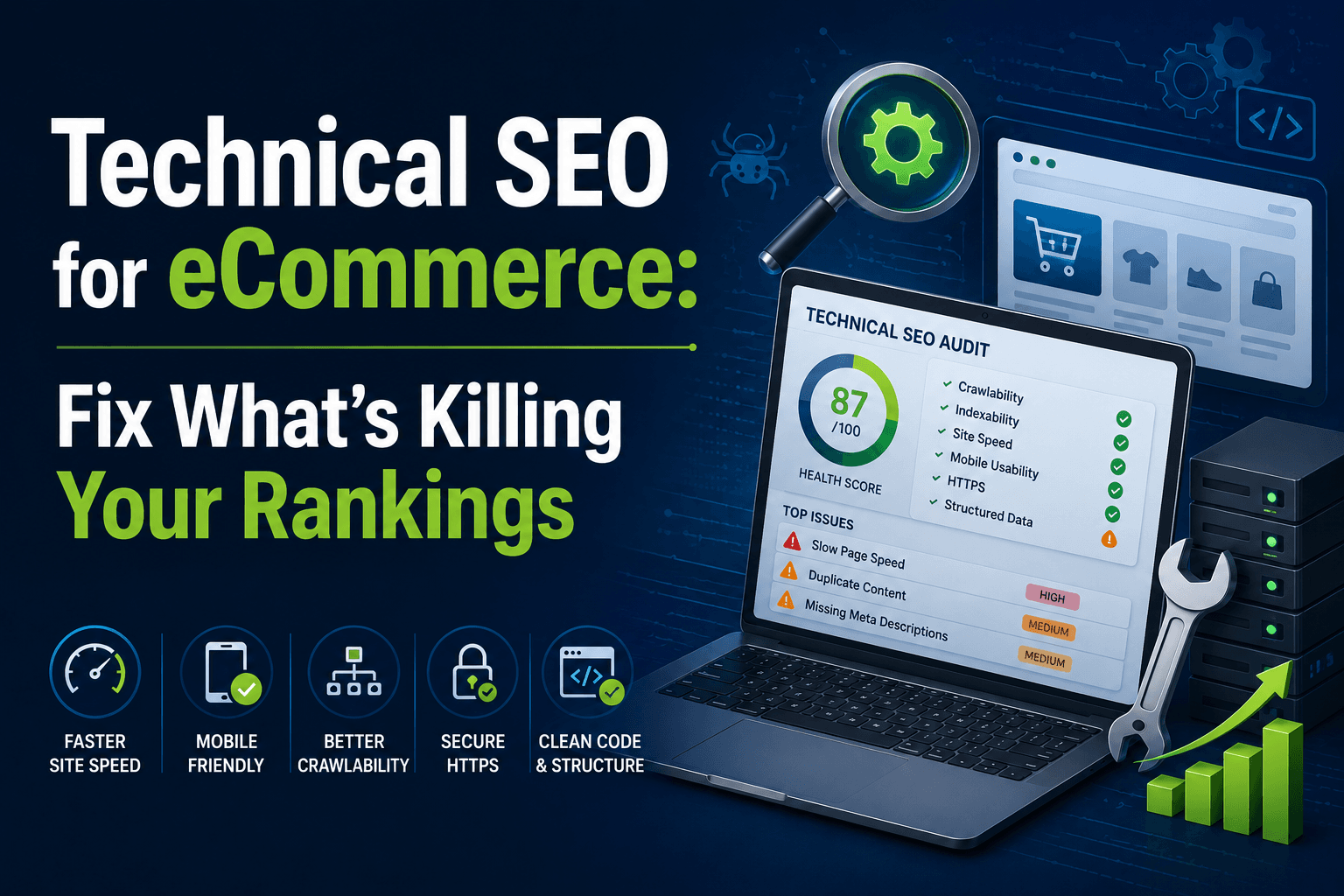
Technical SEO is the foundation. If search engines cannot crawl and index your store efficiently, nothing else matters.
Site Crawlability:
- [ ] All product and category pages return 200 status codes
- [ ] No critical pages blocked by robots.txt
- [ ] All pages reachable within 3 clicks from homepage
- [ ] Internal link structure follows category hierarchy
- [ ] No orphaned product pages (unreachable except via search)
- [ ] Pagination implemented properly (rel="next" and rel="prev" or Load More with JavaScript SEO)
- [ ] JavaScript-rendered content is crawlable (if using React/Vue/Angular)
Indexation Management:
- [ ] XML sitemap includes only indexable pages (canonical URLs for products and categories)
- [ ] No duplicate pages indexed (check "site:yourstore.com" in Google)
- [ ] Out-of-stock products handled with strategy (keep page live with "OutOfStock" schema, or 301 redirect to category)
- [ ] Discontinued products 301 redirect to replacement or relevant category
- [ ] Filtered category pages managed (index only valuable filters, noindex others)
- [ ] Sorted pages canonicalized to default sort
- [ ] Faceted navigation controlled (parameter handling, canonicals, or selective indexing)
Canonical Tags:
- [ ] Every product page canonicals to itself (not to category)
- [ ] Color/size variants canonical to master product page
- [ ] HTTP versions canonical to HTTPS
- [ ] www versions canonical to non-www (or vice versa)
- [ ] Paginated category pages canonical to self, not to page 1
Structured Data (Schema Markup):
- [ ] Product schema on all product pages (name, image, description, brand, SKU, offers)
- [ ] Offer schema with price, currency, availability, and seller
- [ ] Review schema (AggregateRating) if you have reviews
- [ ] Breadcrumb schema on all pages
- [ ] Organization schema on homepage with logo and social profiles
- [ ] Validate schema with Google Rich Results Test
- [ ] Critical 2026 update: Ensure price and availability in schema exactly match on-page display and Merchant Center feed
Why schema is critical in 2026: Product and Offer schema is no longer just for star ratings in search results. It is now the API feeding Google's AI Overviews and AI Mode. If your schema is incomplete or inaccurate (price mismatch, wrong stock status), AI assistants cannot verify your product information in real-time and will not recommend your products. Perfect schema = AI visibility. Broken schema = invisible to AI search.
XML Sitemaps:
- [ ] Separate sitemaps for products, categories, and blog content
- [ ] Sitemap index linking all child sitemaps
- [ ] Submitted to Google Search Console
- [ ] No more than 50,000 URLs per sitemap file
- [ ] Updated automatically when products added/removed
Merchant Center Feed Sync (Critical 2026 Requirement):
- [ ] Google Merchant Center feed configured (if selling on Google Shopping)
- [ ] Product prices in feed match on-page prices exactly
- [ ] Product prices in feed match schema markup prices exactly
- [ ] Stock availability in feed matches on-page display
- [ ] Stock availability in feed matches schema availability field
- [ ] Feed updates automatically when prices or stock change
- [ ] No mismatches that can trigger organic ranking suppression
Why feed sync matters in 2026: Google now cross-references your Merchant Center feed, on-page content, and schema markup. If your page shows $99, your schema says $89, and your feed shows $109, Google suppresses your organic rankings because it cannot trust your data. Technical SEO and feed management are no longer separate—they are inseparable. Price/stock mismatches kill both Shopping ads AND organic rankings.
Page Speed Optimization:
- [ ] LCP (Largest Contentful Paint) under 2.5 seconds
- [ ] INP (Interaction to Next Paint) under 200ms - THE critical 2026 metric
- [ ] CLS (Cumulative Layout Shift) under 0.1
- [ ] Images optimized (WebP format, lazy loading, proper sizing)
- [ ] CSS and JavaScript minified and deferred where possible
- [ ] Server response time under 200ms
- [ ] Use CDN for static assets and images
- [ ] Remove or defer heavy third-party scripts (chatbots, pixels, trackers)
Why INP is the #1 priority in 2026: INP (Interaction to Next Paint) officially replaced FID (First Input Delay) as a Core Web Vital in March 2024. It is now THE definitive metric for "snappiness"—how quickly your site responds when users click buttons or interact with elements. Most eCommerce stores fail here because of heavy third-party scripts: chatbots, Facebook pixels, analytics trackers, and marketing automation tools. These scripts block the main thread, making your site LOOK loaded but feel unresponsive. Users click "Add to Cart" multiple times thinking it is broken. Fix INP first—it impacts both rankings and conversions more than any other metric.
Mobile Optimization:
- [ ] Fully responsive design (all pages work on mobile)
- [ ] Touch-friendly buttons and navigation
- [ ] No horizontal scrolling required
- [ ] Text readable without zooming (16px minimum)
- [ ] Mobile page speed under 3 seconds
- [ ] Mobile-friendly checkout process
Why technical SEO matters for large stores: Google wastes crawl budget on duplicate, low-value pages. Fixing technical issues ensures Googlebot finds and ranks your revenue-generating pages instead of crawling thousands of filter combinations.
Common technical failure: A store with 2,000 products had 47,000 pages indexed due to uncontrolled filter combinations. Google crawled filter pages instead of high-value product and category pages. Implementing proper faceted navigation controls reduced this to 2,500 crawlable pages and rankings improved within 60 days.