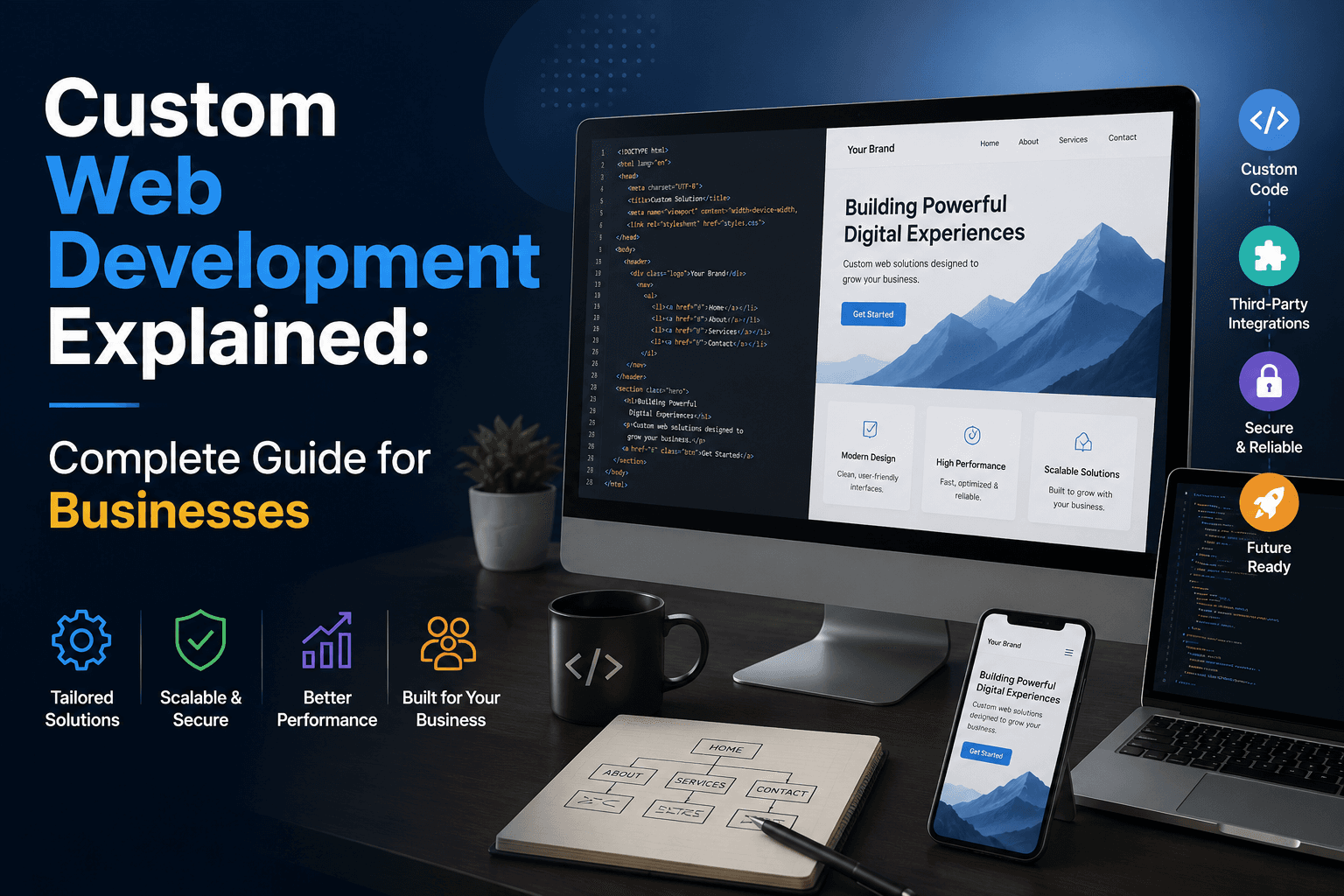
Custom Web Development Explained: Complete Guide for Businesses
You need a website. You know that much.
But when you start researching options, you hit a wall of jargon: custom development, template sites, page builders, CMS platforms, headless architecture, full-stack solutions. Every option sounds expensive, complicated, or both.
This guide cuts through the confusion. It explains what custom web development actually is, when you need it, when you don't, and how to make the decision without wasting money or months of time.
What Is Custom Web Development?
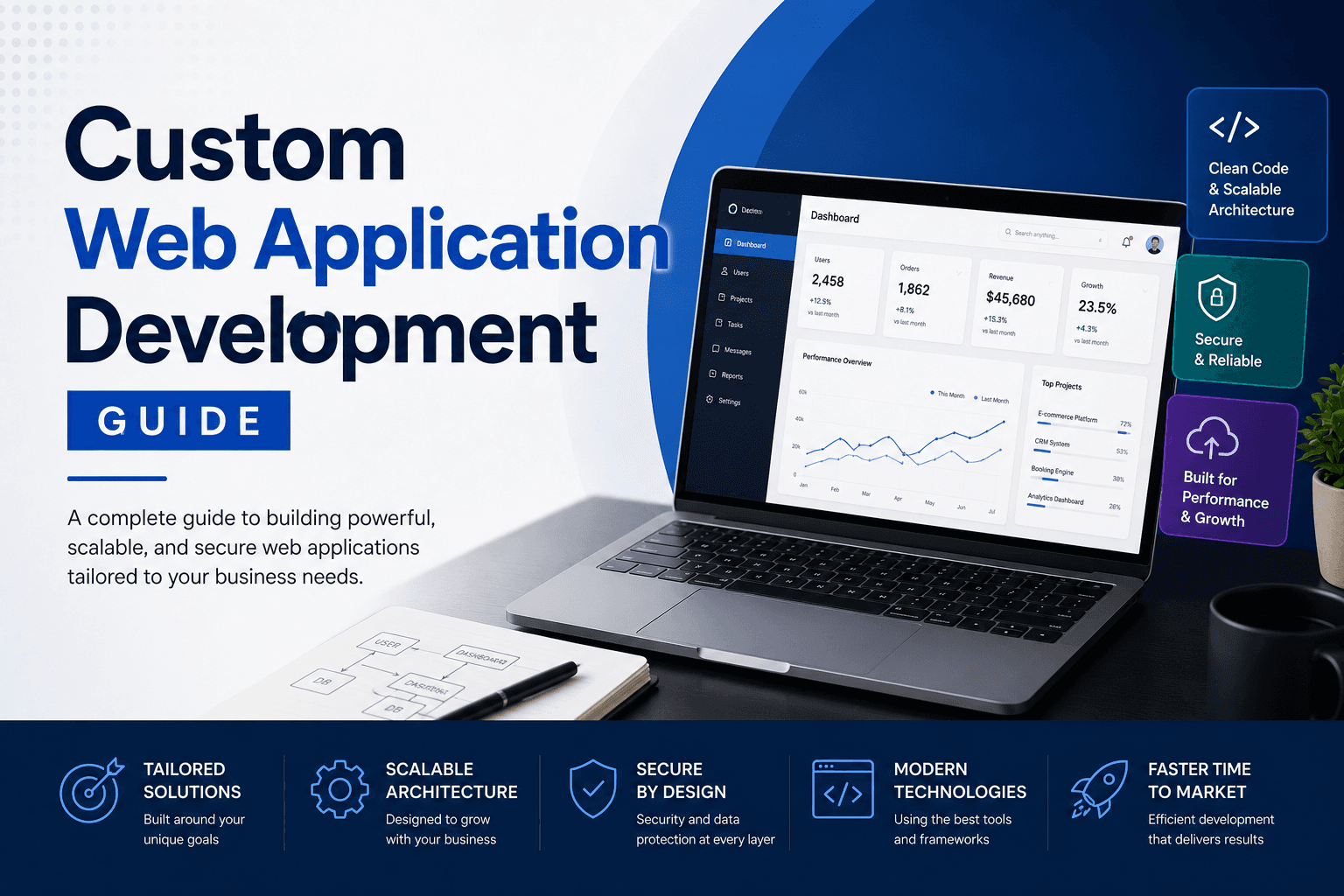
Custom web development is building a website or web application specifically for your business requirements, designed and coded from the ground up rather than using a pre-made template or theme.
Think of it like building a house. A template website is like buying a house in a subdivision where every home uses one of three floor plans. Custom development is hiring an architect to design exactly what you need, then building it to those specifications.
What custom development includes:
- Unique design created specifically for your brand
- Features and functionality built to match your exact business processes
- Database and backend systems tailored to how your business operates
- Complete control over performance, security, and future changes
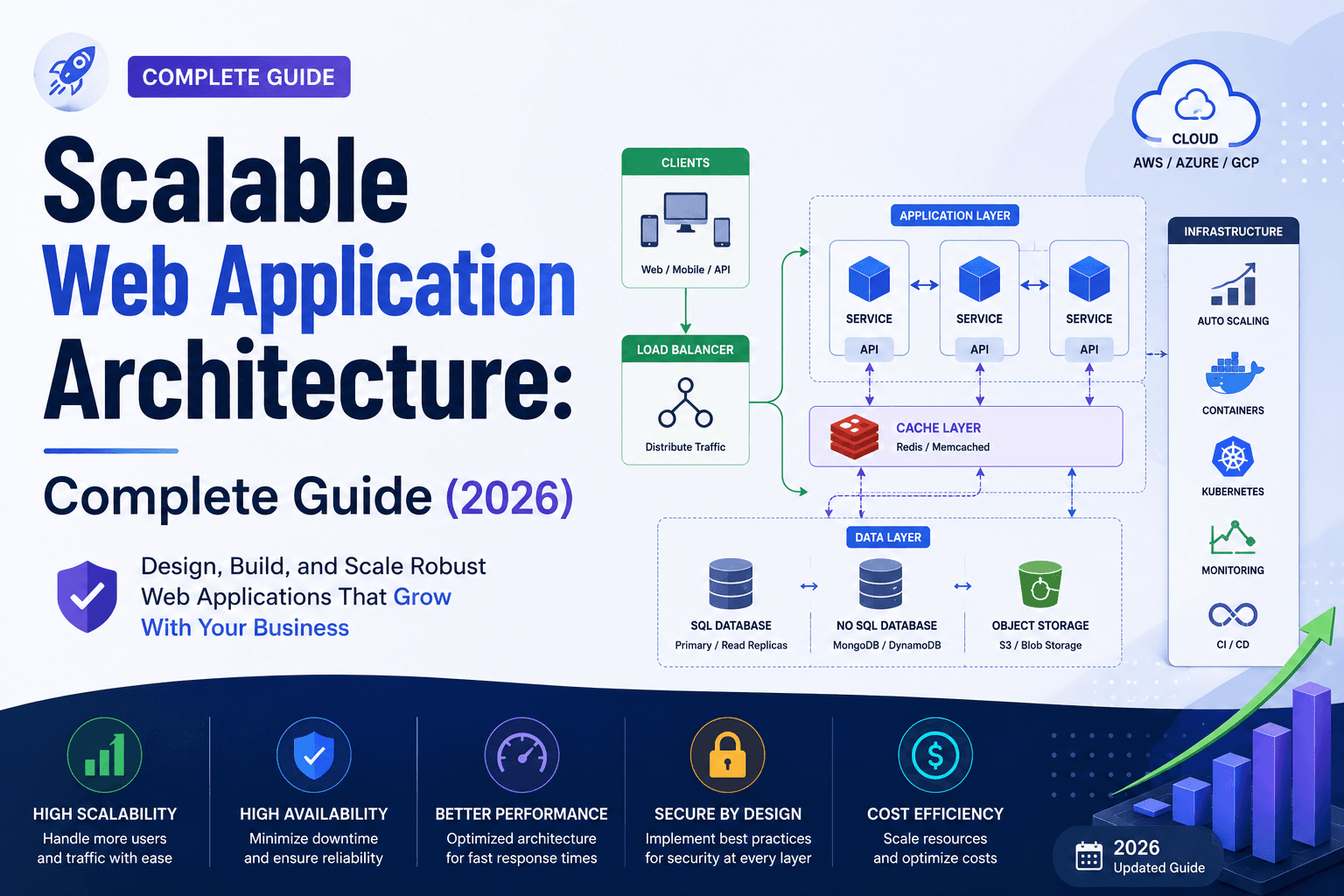
- Scalability designed for your growth trajectory
What it does not include:
- Using pre-built WordPress themes, Shopify templates, or Wix drag-and-drop builders
- Relying on off-the-shelf plugins for core functionality
- Shared hosting environments with limited control
Important clarification: Custom development can still use a CMS like WordPress, Contentful, or Sanity as a headless backend for content management while the frontend is built from scratch in React, Next.js, or Vue. This "headless" architecture combines the content management ease of a CMS with the performance and flexibility of custom-coded frontends. The key is that the user-facing part of your site is built specifically for you, not selected from a template library.
Custom development means you own the architecture. Template solutions mean you rent someone else's.
How Does Custom Web Development Work?
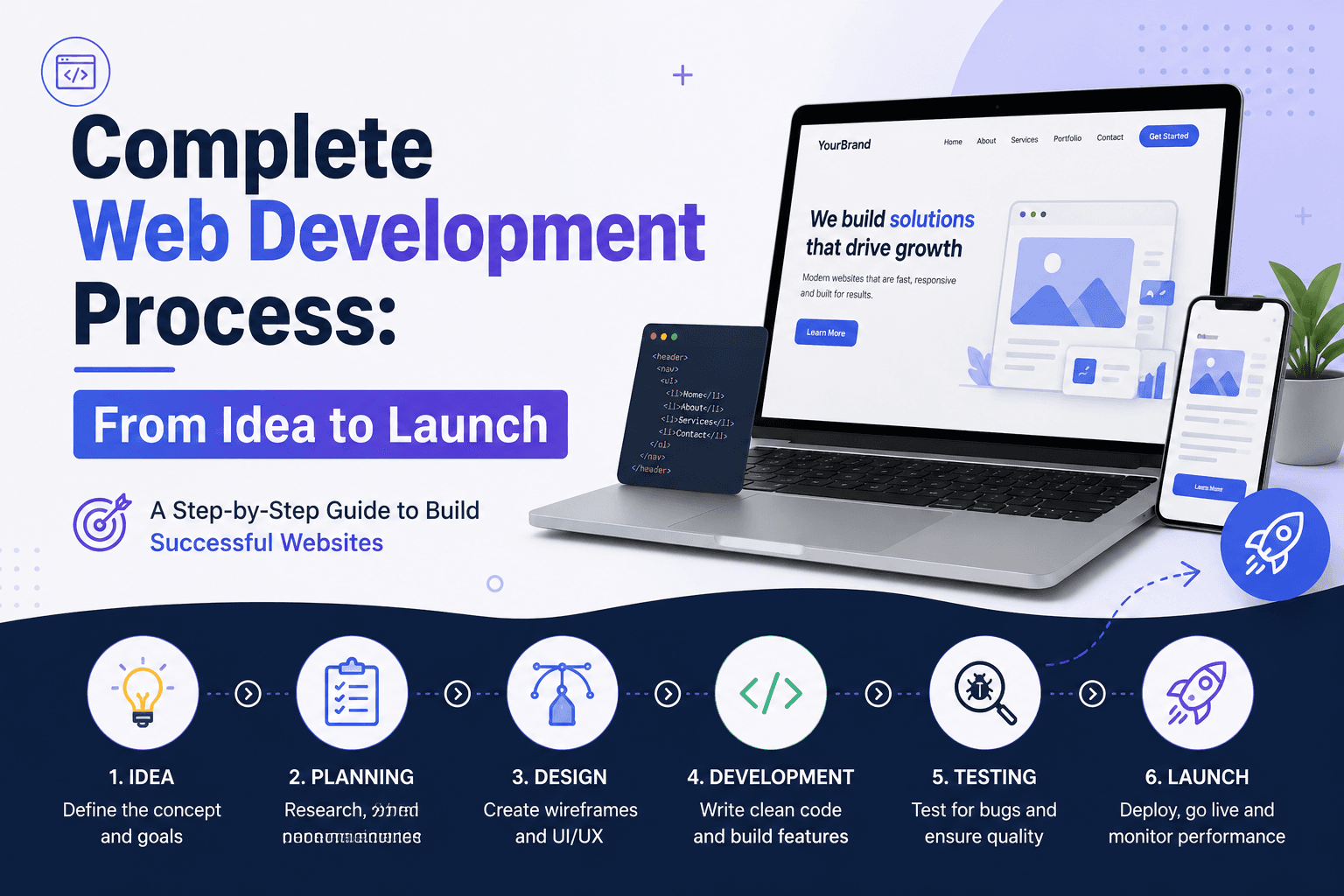
Custom development follows a structured process. Understanding it helps you evaluate timelines and costs realistically.
Phase 1: Discovery and Planning (1 to 3 weeks)
What happens:
- Business requirements gathering
- User research and competitor analysis
- Technical architecture planning
- Feature prioritization
- Project scope definition
Your involvement:
- Explain your business goals, workflows, and pain points
- Identify must-have vs nice-to-have features
- Define success metrics
Phase 2: Design (2 to 4 weeks)
What happens:
- Wireframes showing page structure and flow
- Visual design concepts
- Interactive prototypes
- Design system creation (colours, typography, components)
Your involvement:
- Provide feedback on wireframes and designs
- Supply brand guidelines and existing assets
- Approve final designs before development starts
Phase 3: Development (6 to 16 weeks)
What happens:
- Frontend development (what users see and interact with)
- Backend development (databases, logic, integrations)
- API connections to third-party services
- Content management system integration
- Testing across browsers and devices
Your involvement:
- Weekly progress reviews
- Content preparation
- User acceptance testing
Phase 4: Testing and Launch (2 to 4 weeks)
What happens:
- Quality assurance testing
- Performance optimization
- Security hardening
- SEO setup and redirects if migrating
- Deployment to production servers
Your involvement:
- Final approval before launch
- Training on how to manage the site
- Launch coordination
Phase 5: Post-Launch Support (Ongoing)
What happens:
- Bug fixes and adjustments
- Feature additions as needs evolve
- Security updates and monitoring
- Performance optimization
Your involvement:
- Reporting issues or change requests
- Providing feedback on performance
Timeline varies significantly based on complexity. A simple custom brochure site might take 8 to 12 weeks. A complex web application with integrations, custom dashboards, and eCommerce can take 4 to 9 months.
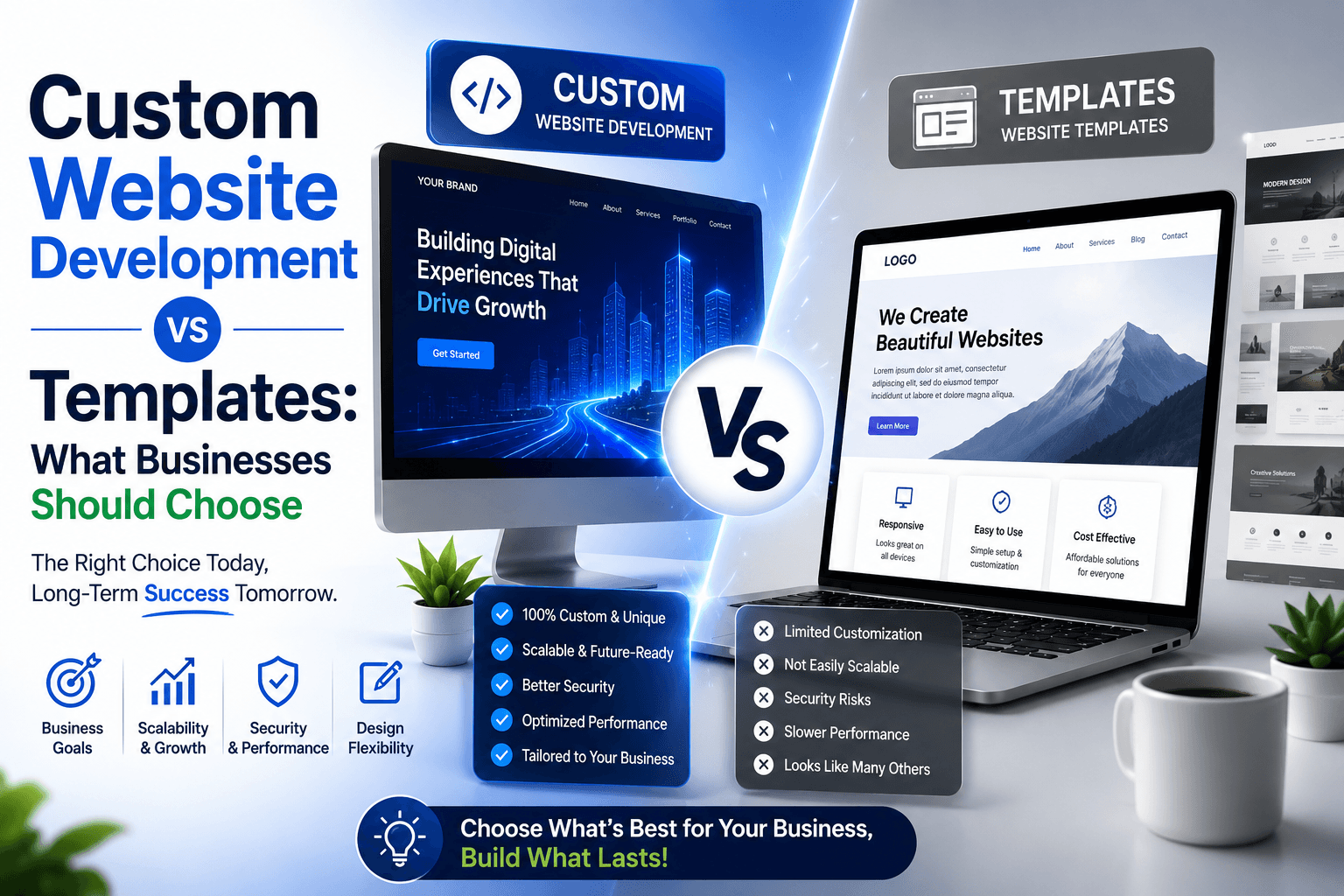
Custom Web Development vs Template Websites: The Real Differences
This is the decision most businesses struggle with. Here is an honest comparison.
Factor | Template Websites | Custom Development |
Setup time | Days to weeks | 2 to 6+ months |
Upfront cost | $500 to $5,000 | $15,000 to $150,000+ |
Design uniqueness | Limited (shared templates) | Completely unique |
Functionality | What the template/plugins offer | Anything you need |
Scalability | Hits limits as you grow | Built to scale with you |
Performance (Core Web Vitals) | Often bloated with unused code | Full INP and CWV optimization |
Integrations | Plugin-based (rigid dependencies) | API-first / headless architecture |
AI capabilities | Basic chatbot plugins | Custom LLM integration, RAG, proprietary AI |
Accessibility (WCAG 2.2) | Often fails compliance audits | Native accessibility from day one |
Maintenance | Plugin/theme updates required | Your developer manages |
Ownership | Limited (platform lock-in) | Total intellectual property ownership |
SEO control | Platform constraints apply | Complete technical control |
When it fails you | When you outgrow its capabilities | When budget or timeline don't fit |
The honest truth: Templates are better for testing, speed to market, and limited budgets. Custom development is better for competitive differentiation, complex requirements, and long-term scalability.
Neither is universally superior. They solve different problems.
What Are Custom Web Development Services?
Custom web development is not one service. It is a collection of specialized capabilities that combine to build your solution.
Frontend Development
Building the user-facing parts of your website using HTML, CSS, and JavaScript frameworks (React, Vue, Angular). This is everything your visitors see and interact with.
When you need it:
- Your design is unique and cannot be achieved with templates
- You need complex interactions or animations
- Performance and mobile experience are critical
Backend Development
Building the server-side logic, databases, and APIs that power your application. This is the engine that makes everything work.
When you need it:
- You process user data, orders, or applications
- You need custom business logic
- You integrate with other systems (CRM, inventory, payment processors)
Full-Stack Development
Combining both frontend and backend development into a complete solution.
When you need it:
- Building web applications, not just websites
- Your project requires both user interface and complex backend functionality
API Development and Integration
Building connections between your website and third-party services or creating APIs others can use.
When you need it:
- Syncing data between your website and business software
- Pulling information from multiple sources into one interface
- Offering programmatic access to your platform
eCommerce Development
Building custom online stores with unique checkout flows, inventory management, and payment integrations.
When you need it:
- Your products have complex attributes or configurations
- You need custom shipping, tax, or fulfillment logic
- You're selling subscriptions, rentals, or digital products with unique delivery needs
How Much Does Custom Web Development Cost?
Cost varies significantly based on project complexity, features, design requirements, and timeline.
Simple Custom Websites ($15,000 to $30,000)
Brochure sites, portfolio sites, and small business websites with basic functionality. Typically includes a custom design, CMS integration, contact forms, and basic SEO setup.
Corporate Websites with CMS ($30,000 to $80,000)
Multi-page sites with custom functionality, member areas, content workflows, integrations with business tools (CRM, marketing automation), and more complex design systems.
eCommerce Stores ($50,000 to $150,000)
Online stores with custom product catalogues, checkout flows, inventory management, payment gateway integration, shipping calculation, and order management.
Web Applications ($100,000 to $500,000+)
Complex applications including dashboards, user management, real-time features, API integrations, and SaaS platforms. Enterprise builds can exceed $500,000.
Agencies that quote significantly below these ranges either outsource offshore or underestimate scope, both of which create problems later.
When Should You Choose Custom Development Over Templates?
Custom development is the right choice when:
- Your competitive advantage depends on unique digital capabilities
- You have complex business logic that templates cannot accommodate
- You process high transaction volumes where performance directly impacts revenue
- You need deep integrations with your existing business systems
- You anticipate significant scaling and need architecture that grows with you
- Security and compliance requirements exceed what standard platforms offer
- You want full ownership and control over your digital assets
Templates are better when:
- You need to launch quickly (days or weeks, not months)
- Budget is limited and fixed
- Your requirements are straightforward and templates cover them well
- You're testing a market or business concept
- You don't have internal technical resources to manage custom code
How to Choose a Custom Web Development Partner
Finding the right development partner matters more than the technology choice. Here's what to evaluate:
Portfolio and Relevant Experience
Review their previous work, particularly projects similar in complexity to yours. Ask for case studies that show business outcomes, not just screenshots.
Process Transparency
They should explain their development process, communication cadence, and how they handle scope changes. Beware of fixed-price quotes for complex projects without detailed specifications.
Technical Expertise
Understand their technology stack and why they recommend it. They should be able to explain trade-offs between approaches, not just push the latest framework.
Post-Launch Support
Custom sites need ongoing maintenance. Ensure they offer support packages, understand their response time commitments, and what happens when things break.
Final Thoughts
Custom web development is an investment. Done right, it gives you digital capabilities that competitors cannot easily copy. Done wrong, it wastes money and leaves you with code nobody can maintain.
The decision framework is simple: if templates can solve your problem today, use templates. If templates will constantly fight you and limit what you can build, invest in custom development.
Most businesses that start with templates and outgrow them knew it was coming. The question is whether you plan for that transition or get forced into it.
For businesses evaluating whether SEO limitations justify custom development investment, read our guide on why SEO is important for eCommerce growth. To understand when bringing in outside help makes sense, see our article on should I hire an SEO agency. Explore our custom web development services to see how we build scalable, SEO-optimized solutions for growing businesses across Australia.