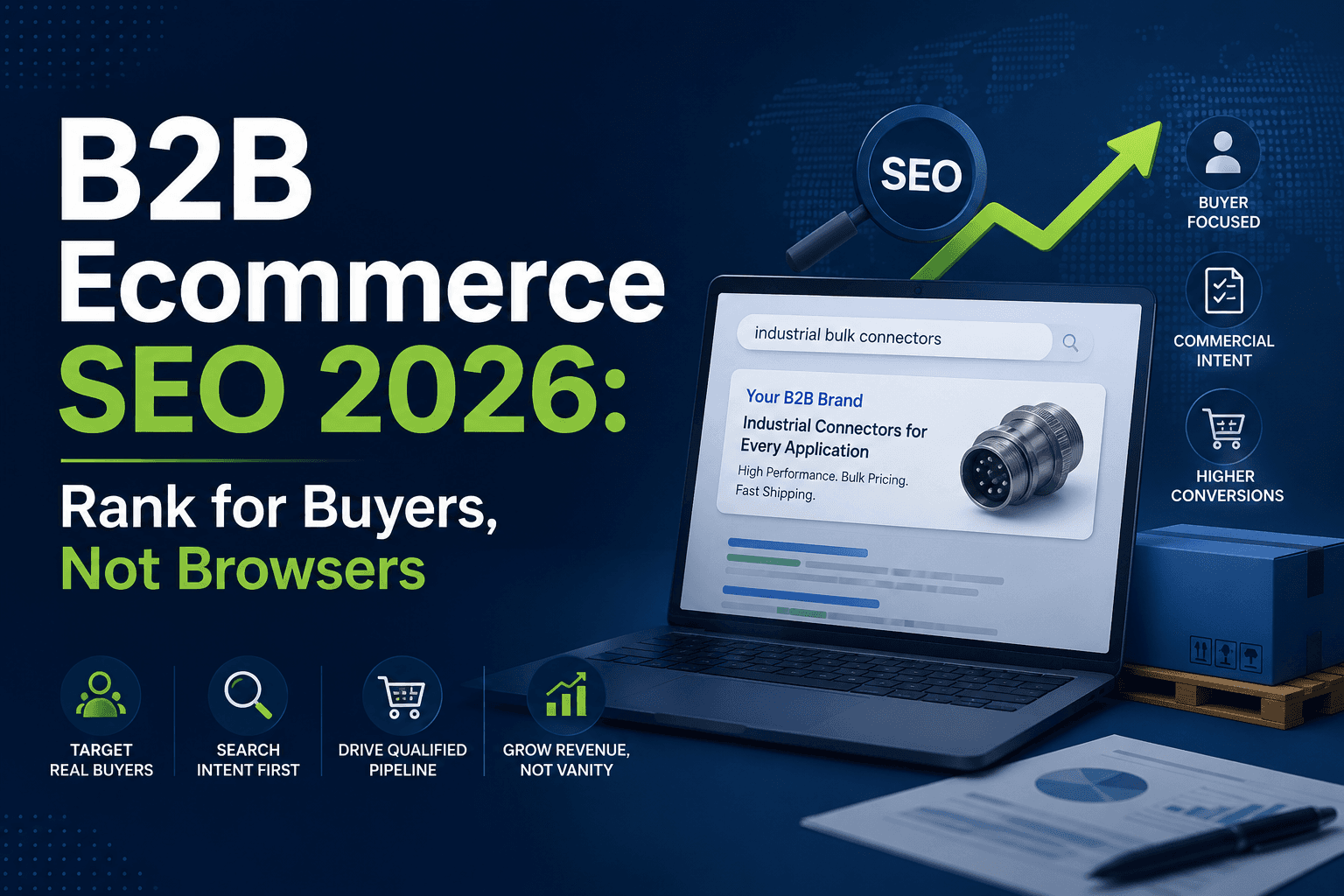
B2B Ecommerce SEO: How to Drive Qualified Wholesale & Trade Buyers from Organic Search
B2B eCommerce SEO is not about traffic volume—it is about lead quality.
A B2C store celebrating 10,000 monthly visitors at 2% conversion ($50 AOV) generates $10,000 monthly revenue. A B2B store with 500 monthly visitors at 8% conversion ($5,000 AOV) generates $50,000 monthly revenue—plus $500,000 annual value from those 10 repeat accounts.
Most SEO strategies are built for B2C: broad keywords, volume metrics, consumer intent. Apply these to B2B eCommerce and you attract tire kickers who waste sales team time filtering unqualified inquiries.
In 2026, the goal is not to rank for broad terms attracting home-office browsers. It is to rank for specific technical queries used by procurement managers and operations directors—the people with budget, authority, need, and timeline (BANT).
This is the revenue blueprint for B2B eCommerce SEO where traffic is a vanity metric and pipeline value is the only KPI that matters.
B2B vs B2C: The Strategic Divide
In B2B, traffic is a vanity metric. Lead quality is the only KPI that matters.
Factor | B2C (Consumer) | B2B (Wholesale/Trade) |
Search Goal | Discovery & impulse purchase | Specifications, compliance verification, ROI evaluation |
Keywords | Broad consumer terms ("work boots," "office supplies") | Niche technical terms ("Industrial Safety Boots AS/NZS 2210," "Bulk Office Supplies Wholesale Australia Trade Account") |
Search Volume | High (10,000+ monthly searches) | Low (50-500 monthly searches per qualified keyword) |
Decision Process | Individual consumer (minutes to hours) | Committee/procurement approval (3-12 months, multiple stakeholders) |
Average Order Value | $50-$500 one-time purchase | $5,000-$500,000 recurring contract value |
Success Metric | Conversion rate (orders placed, revenue generated) | Pipeline value (qualified leads, deal size, customer lifetime value) |
Content Depth | 300-500 words product descriptions | 2,000+ words technical specifications, compliance documentation, ROI calculators |
Pricing Display | Upfront prices, promotions, "Add to Cart" | "Request Trade Pricing," volume discount tiers, account terms (Net 30/60) |
Trust Signals | Customer reviews, star ratings | Case studies with measurable ROI, industry certifications, compliance docs, client lists |
The strategic implication: Optimizing for "office supplies" (100,000 searches, 99% consumers) wastes resources. Optimizing for "bulk office supplies wholesale distributor trade account Australia" (150 searches, 85% qualified procurement managers) builds pipeline value.
Why B2C tactics actively harm B2B:
Ranking #1 for "office supplies" attracts:
- 99,000 home office consumers buying $20 pen sets
- 900 small businesses buying single boxes
- 100 procurement managers with $50,000 annual contracts
Sales team spends 90% of time filtering unqualified inquiries, 10% closing high-value accounts.
Ranking #1 for "bulk office supplies wholesale Australia" attracts:
- 400 procurement managers with purchasing authority
- 70 office managers researching suppliers
- 30 competitors/price shoppers
Sales team spends 80% of time closing qualified accounts, 20% on qualification.
The revenue difference: Same sales team capacity, 8x more qualified conversations, 12x higher monthly revenue.
For enterprise-scale technical implementation, our technical SEO for eCommerce guide covers B2B catalog considerations.
The 5 Pillars of B2B Ecommerce SEO
1. Keyword Strategy: Niche, Specific, Intent-Qualified
The Problem: Targeting broad consumer keywords ("office chairs") attracts 10,000 consumers buying one chair for $200 instead of 100 procurement managers sourcing 500 chairs for $100,000 contracts.
What to target:
Industry-specific modifiers:
- "Industrial safety boots AS/NZS 2210.3" (not "work boots")
- "Food grade stainless steel commercial kitchen equipment" (not "kitchen equipment")
- "Pharmaceutical grade peptides bulk wholesale" (not "peptides")
Bulk and wholesale intent:
- "Bulk office supplies wholesale distributor Australia"
- "Industrial packaging materials supplier Melbourne"
- "Commercial cleaning supplies bulk order"
- "Wholesale electrical components trade account"
Supplier and manufacturer searches:
- "Stainless steel fabrication supplier Sydney"
- "PPE equipment manufacturer Australia"
- "Commercial HVAC parts distributor"
- "Industrial fasteners supplier bulk"
Technical and specification searches:
- "M8 stainless steel bolts grade 316 bulk"
- "Cat6 ethernet cable 305m drum wholesale"
- "Industrial safety gloves EN 388 level 4"
Account and terms searches:
- "Trade account office supplies Australia"
- "Net 30 payment terms industrial supplies"
- "Corporate account cleaning supplies Melbourne"
Do this, not that:
- ✅ Target: "Industrial safety footwear bulk supplier Australia AS/NZS 2210" (50 monthly searches, 100% qualified)
- ❌ Target: "Work boots" (10,000 monthly searches, 1% qualified)
- ✅ Target: "Commercial kitchen equipment stainless steel supplier Sydney" (80 monthly searches, 90% qualified)
- ❌ Target: "Kitchen equipment" (50,000 monthly searches, 0.5% qualified)
- ✅ Target: "Office supplies wholesale distributor trade account Melbourne" (120 monthly searches, 85% qualified)
- ❌ Target: "Office supplies" (100,000 monthly searches, 0.1% qualified)
The outcome: 500 highly qualified visitors converting at 8% instead of 10,000 unqualified visitors converting at 0.5%. Higher revenue, lower customer acquisition cost, sales team focuses on qualified opportunities.
2. Category Pages for Wholesale Intent
The Problem: B2C category pages show individual product prices, "Add to Cart" buttons, and consumer-focused descriptions. B2B buyers need pricing tiers, MOQ (minimum order quantity), bulk capabilities, and technical specifications.
B2B category page requirements:
Wholesale intent signals:
- "Request Trade Pricing" instead of displayed prices
- "Bulk Order Enquiry" CTAs
- MOQ (Minimum Order Quantity) information
- Volume discount tiers explained
- Account setup process outlined
- Payment terms (Net 30, Net 60) mentioned
Industry segmentation: Instead of generic categories like "Safety Equipment," segment by industry application:
- Construction Safety Equipment
- Manufacturing Safety Equipment
- Mining Safety Equipment
- Hospitality Safety Equipment
Technical information priority:
- Specifications downloadable (PDF spec sheets)
- Compliance certifications displayed (AS/NZS standards, ISO certifications)
- Compatibility guides linked
- Application notes available
- Technical support contact visible
Content focus:
- Solution-oriented (not product-feature focused)
- ROI and total cost of ownership
- Durability and lifecycle cost
- Procurement process support
- Bulk packaging and delivery options
Do this, not that:
- ✅ "Industrial Safety Footwear: AS/NZS 2210 Certified - Bulk Pricing Available"
- ❌ "Work Boots Collection - Shop Now"
- ✅ "Request Quote for Volume Pricing" CTA
- ❌ "$79.95 - Add to Cart" CTA
- ✅ "MOQ: 50 pairs | Delivery: 5-7 business days | Account Terms: Net 30"
- ❌ "Free shipping on orders over $100"
The outcome: Category pages qualify leads before sales contact. Procurement managers find pricing structures, technical specs, and account information. Consumers bounce immediately (self-filtering). Sales team receives qualified inquiries only.
3. Account-Based Content Strategy: Targeting Decision-Makers
The Problem: Generic content attracts generic traffic. B2B requires content targeting specific industries, roles, and business challenges.
Account-based content types:
Industry-specific buying guides:
- "Complete Guide to Sourcing Industrial Safety Equipment for Construction Sites (2026 AS/NZS Compliant)"
- "Foodservice Equipment Selection for Commercial Kitchens: A Procurement Manager's Checklist"
- "Office Supplies Vendor Assessment Framework for Procurement Teams"
Role-specific content:
- Procurement Manager: "How to Evaluate Wholesale Suppliers: 12-Point Compliance Checklist"
- CFO/Finance Director: "Total Cost of Ownership Analysis: Why B2B Suppliers Beat Consumer Pricing"
- Operations Director: "Supply Chain Resilience: Building冗余 with Dual-Source Wholesale Accounts"
ROI and business case content:
- "Wholesale Account ROI Calculator: Compare Consumer vs Trade Pricing"
- "Case Study: How [Construction Company] Reduced Procurement Costs 40% with Trade Accounts"
- "Business Case Template: Justifying Bulk Supplier Switch to Finance"
Technical and specification content:
- "AS/NZS 2210.3:2024 Safety Footwear Standards Explained"
- "Stainless Steel Grade Selection Guide for Food Processing Applications"
- "Industrial Ethernet Cable Specifications: Cat6 vs Cat6a vs Cat7 for Manufacturing"
Sales cycle content mapping:
Map content to buyer journey stages:
- Problem identification: Industry-specific challenges and compliance requirements
- Solution research: Vendor comparison frameworks, compliance checklists
- Stakeholder buy-in: ROI calculators, case studies, business case templates
The outcome: Content reaches decision-makers directly. Procurement managers, CFOs, and operations directors find role-specific resources. Content supports 6-12 month B2B sales cycles with appropriate resources at each stage.
4. Technical SEO: B2B Catalog Optimization
The Problem: B2C technical SEO tactics ignore B2B buyer needs: specification searches, compliance documentation, trade account information.
Technical requirements for B2B eCommerce:
URL structure for B2B:
- Include industry/application modifiers: /safety-boots/construction/mining
- Specification-based URLs: /stainless-steel-sheet-304-2mm-1200x2400mm
- Trade/wholesale intent: /bulk-office-supplies-wholesale-australia
Structured data for B2B:
- Product structured data with trade pricing, MOQ, SKU
- BreadcrumbList for industry > category > subcategory navigation
- FAQ schema for common procurement questions
- Organization schema with certifications and compliance info
Page speed for B2B:
B2B buyers often research on-site during work hours. Fast page loads critical for:
- PDF spec sheet downloads (optimize file sizes)
- Technical comparison tables
- Account application forms
Internal linking for B2B:
- Specification to specification (cross-reference compatible products)
- Industry guide to category pages (connect related products)
- Case study to product pages (demonstrate real-world application)
Site architecture for B2B catalogs:
- Hierarchical: Industry > Application > Category > Subcategory > Product
- Filterable by specification (material, size, compliance standard)
- Trade account landing pages at category level
The outcome: Technical infrastructure supports B2B buyer workflows: specification searches, compliance verification, multi-stakeholder evaluation. Site architecture reflects B2B procurement processes.
5. Lead Quality: BANT Qualification Before Sales Handoff
The Problem: Most B2B leads are unqualified. Sales teams waste time on tire-kickers while high-value prospects slip through.
SEO-qualified lead framework:
BANT criteria embedded in content:
- Budget: Trade pricing pages, volume discount tiers, ROI calculators
- Authority: Decision-maker content (CFO analysis, procurement checklists)
- Need: Technical specifications, compliance documentation, application guides
- Timeline: Procurement calendar content, seasonal buying guides
Self-qualification through content:
Design content so unqualified visitors self-select out:
- MOQ displayed prominently (filters small orders)
- Trade account requirements listed
- Technical specifications requiring industry knowledge
- Net 30/60 payment terms mentioned upfront
Lead scoring through engagement:
Track qualified engagement signals:
- PDF specification downloads (indicates technical evaluation)
- ROI calculator usage (indicates budget/authority research)
- Trade account application submission (high intent)
- Multiple category page visits (indicates broad procurement need)
Content-to-lead mapping:
Each content piece should generate qualified leads:
- Industry guide → Request Quote CTA
- ROI calculator → Schedule Demo CTA
- Case study → Contact Sales CTA
- Technical spec → Request Sample CTA
The outcome: SEO generates pre-qualified leads meeting BANT criteria. Sales team receives fewer inquiries with higher conversion rates. 500 qualified leads converting at 20% outperforms 10,000 unqualified leads converting at 1%.
Measuring B2B Ecommerce SEO Success
The problem: Most SEO metrics are B2C-focused: traffic volume, bounce rate, page views. These are vanity metrics for B2B.
B2B SEO KPIs that matter:
Lead quality metrics:
- Percentage of leads meeting BANT criteria
- Sales acceptance rate (leads accepted by sales team)
- Average deal size from organic leads
- Time to qualification (how fast leads become sales-ready)
Pipeline value metrics:
- Pipeline value generated from organic search
- Win rate for organic vs other channels
- Average sales cycle length for organic leads
- Customer acquisition cost by channel
Account lifetime value:
- First order value from organic accounts
- Repeat order rate and frequency
- 3-year customer lifetime value by acquisition channel
- Account expansion revenue
Revenue attribution:
- Assisted conversions (organic touchpoints in multi-touch journey)
- Multi-touch attribution for B2B buying journeys
- Cost per qualified lead by keyword category
- Revenue per organic visitor (not just traffic)
The outcome: SEO investment tied directly to revenue. Clear ROI demonstration for continued investment. Focus shifts from vanity metrics (rankings, traffic) to business outcomes (pipeline value, customer lifetime value).
The 2026 B2B Ecommerce SEO Roadmap
B2B eCommerce SEO in 2026 requires a fundamental shift from B2C tactics:
- Keyword strategy: Niche, specific, intent-qualified keywords over broad consumer terms
- Category optimization: Wholesale-intent signals, industry segmentation, technical depth
- Content strategy: Account-based content targeting decision-makers by role and industry
- Technical SEO: B2B catalog structure, specification searches, compliance documentation
- Lead qualification: BANT criteria embedded in content, self-qualification through UX
The revenue impact: 500 qualified visitors at 8% conversion ($5,000 AOV) generates $200,000 monthly. This is B2B eCommerce SEO where pipeline value replaces traffic as the success metric.
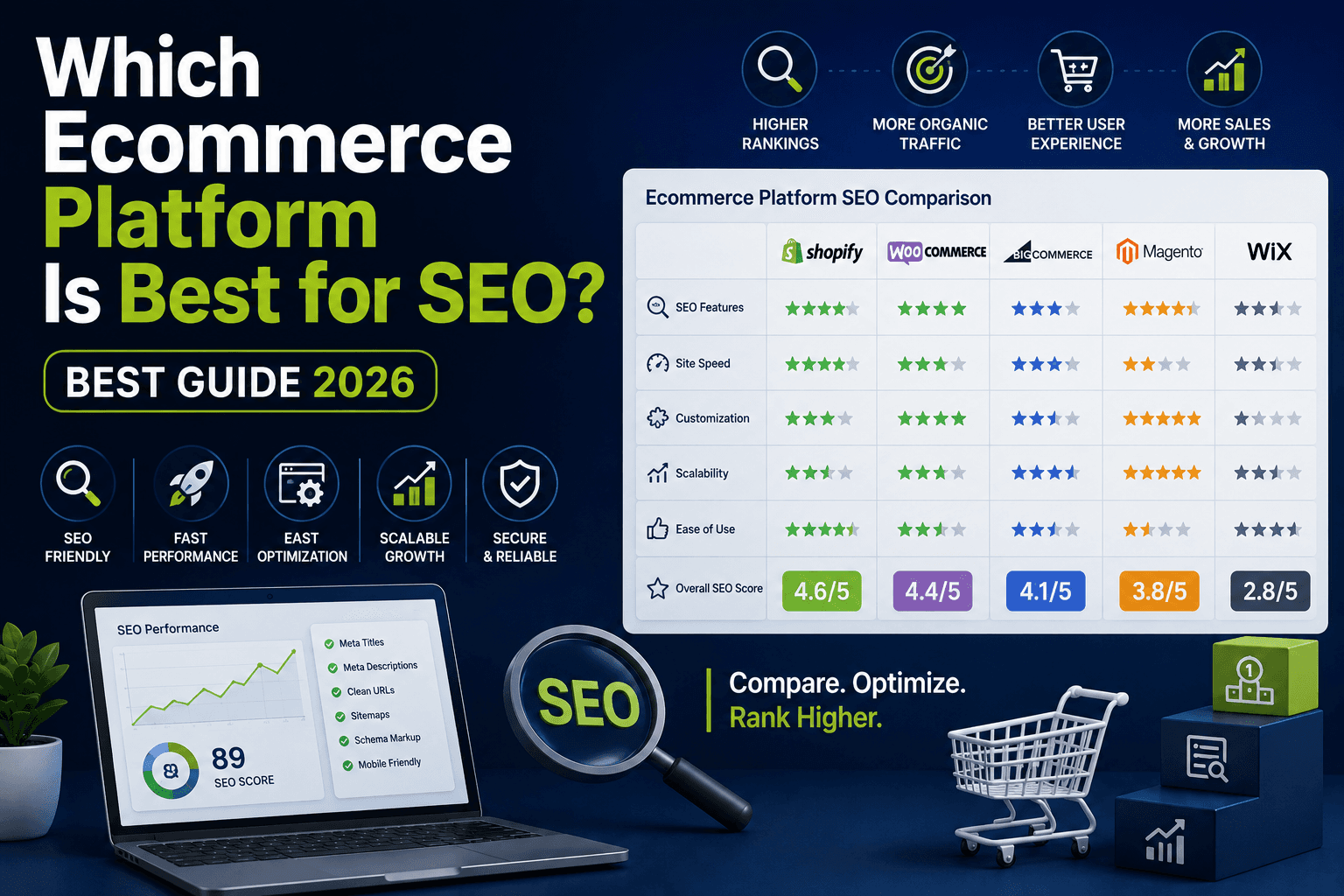
For enterprise technical implementation, read our technical SEO for eCommerce guide. For avoiding common pitfalls, see our common eCommerce SEO mistakes guide. For platform selection supporting B2B workflows, explore our guide on which eCommerce platform is best for SEO. For platform-specific tactics, review our Shopify SEO guide. Contact our team at thedevelopment.com.au/contact-us for B2B eCommerce SEO strategy consultation.