The Platform Decision That Will Shape Your eCommerce Business
Choosing the wrong eCommerce platform is one of the most expensive mistakes an Australian online retailer can make. Not because the platform costs too much upfront. Because migrating off the wrong platform 18 months later, when you have built up SEO equity, integrated your payment systems, and trained your team, is a project that eats time, money, and rankings.
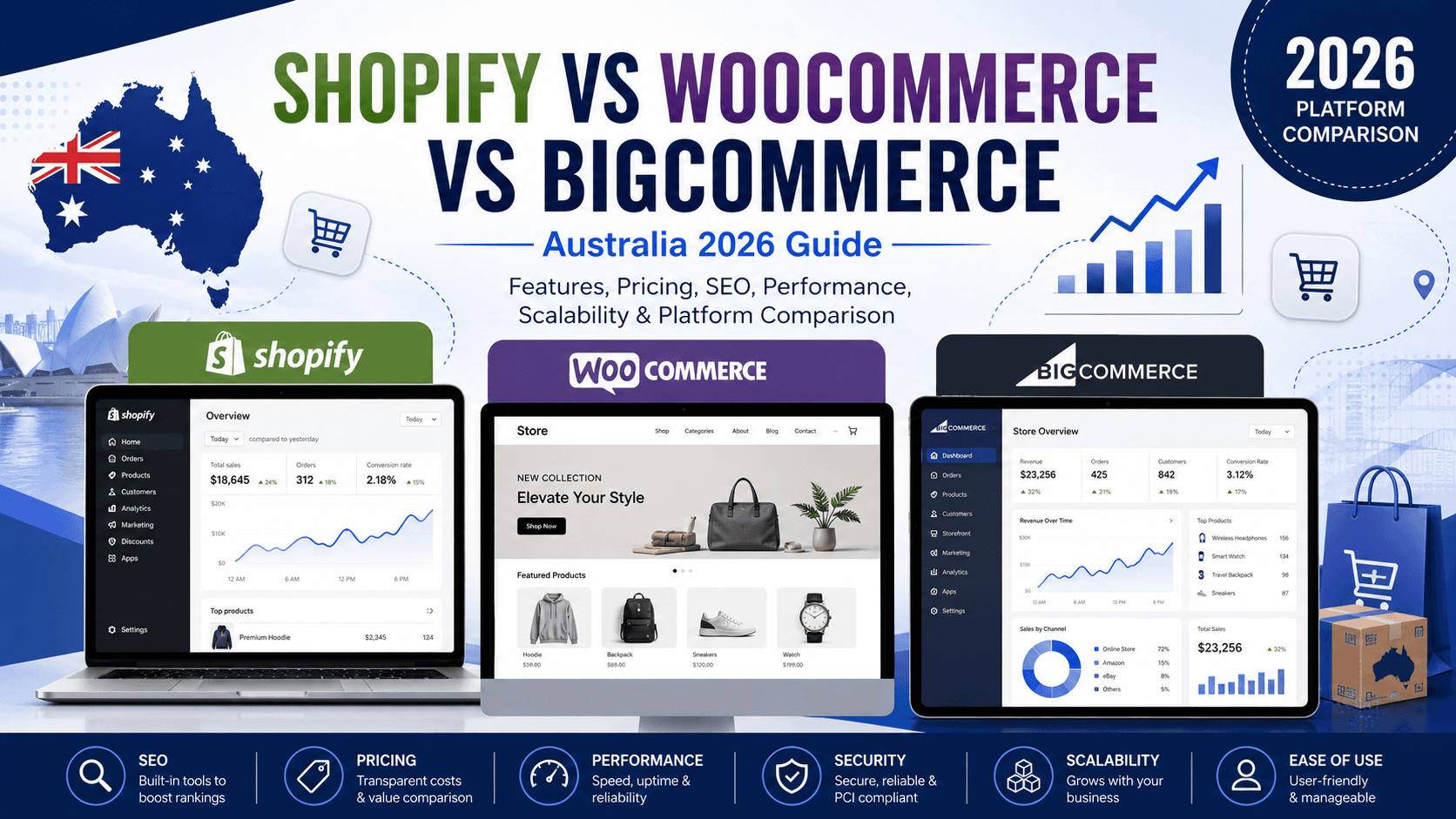
Shopify, WooCommerce, and BigCommerce dominate the Australian eCommerce market. Each is capable of powering a successful online store. Each has meaningful differences in cost, flexibility, SEO capability, and how well it handles Australian-specific requirements like GST calculation, Afterpay integration, and Australia Post connectivity.
This guide is written for Australian business owners and marketing managers who need a clear, practical answer rather than a generic global comparison. We will cover what actually matters in the Australian market context and give you a clear recommendation based on where your business is right now.
Platform Overview: What Each One Is Built For
Shopify
Shopify is a fully managed, cloud-hosted eCommerce platform built for ease of use at every scale. You do not manage servers, security patches, or hosting. The platform handles all of that. Your focus is on selling.
In Australia, Shopify is the dominant choice for direct-to-consumer brands, fashion and lifestyle stores, and founders launching their first serious online store. Shopify Payments removes transaction fees entirely when used as your payment gateway, which is significant given that Shopify charges up to 2 percent on sales processed through third-party gateways on lower plan tiers.
The platform's strengths are its speed to market, its extensive app ecosystem, and its built-in multichannel selling capability across Google Shopping, Meta, and other channels. Its limitation is that deep customisation at the code level requires developer access and Shopify-specific expertise.
WooCommerce
WooCommerce is a free, open-source plugin that converts a WordPress website into a fully functional online store. It is the most installed eCommerce solution in the world by volume, largely because the core plugin costs nothing and WordPress powers a significant share of all websites globally.
The free-to-install positioning is somewhat misleading. Running a production WooCommerce store requires managed WordPress hosting, a premium theme, SSL, and several paid plugins before you have feature parity with a basic Shopify plan. A well-built WooCommerce store typically costs between $20 and $150 per month in ongoing infrastructure costs, plus developer time for setup and maintenance.
Where WooCommerce genuinely excels is SEO flexibility and content integration. Because it runs on WordPress, your eCommerce store and your content strategy share a single platform. For businesses where organic search and content are primary growth channels, that integration is a meaningful advantage.
BigCommerce
BigCommerce sits between Shopify and WooCommerce in the market. It is cloud-hosted like Shopify but includes more built-in features out of the box, reducing dependence on paid apps. It charges no platform transaction fees regardless of which payment gateway you use.
BigCommerce's native strength is in B2B eCommerce. Wholesale pricing tiers, customer-specific catalogues, quote management, and purchase order support are built into the platform rather than requiring third-party solutions. For Australian businesses operating across both B2B and B2C channels, that native capability has real value.
The platform is also well regarded for structured data generation and URL customisation, both of which contribute to strong SEO performance in competitive categories.
Head-to-Head Comparison: What Matters Most for Australian Businesses
The table below covers the factors that Australian eCommerce businesses consistently ask about.
|
Factor |
Shopify |
WooCommerce |
BigCommerce |
|
Hosting |
Fully managed |
Self hosted (you manage) |
Fully managed |
|
Setup speed |
Fast (hours) |
Moderate (days) |
Moderate (days) |
|
Monthly cost |
$39 to $399 AUD approx. |
$20 to $150 AUD hosting plus plugins |
$39 to $399 AUD approx. |
|
Transaction fees |
0% with Shopify Payments; up to 2% third party |
None on platform |
None ever |
|
Customisation |
Good via apps; limited at code level |
Unlimited with developer |
Good; less flexible than WooCommerce |
|
SEO capability |
Solid; some URL limitations |
Excellent with Yoast or Rank Math |
Strong; structured data built in |
|
GST compliance |
Built in for AU |
Via WooTax or plugin |
Built in for AU |
|
Afterpay/Zip |
Native support |
Plugin required |
Native support |
|
Content (blog) |
Basic |
Excellent via WordPress |
Basic |
|
B2B features |
Via apps only |
Via plugins |
Built in natively |
|
Best for |
Most AU SMBs and DTC brands |
Content first or highly custom stores |
Mid market and B2B brands |
Australian-Specific Considerations
GST Compliance
GST handling is a non-negotiable requirement for any Australian online retailer. Shopify and BigCommerce both include built-in GST calculation features for Australian stores. WooCommerce requires a plugin such as WooTax or the standard WooCommerce Tax settings configured correctly for Australian rates.
For most WooCommerce stores, this is a simple setup task. But it is worth confirming with your developer or agency before launch to ensure ATO compliance from day one.
Afterpay and Buy Now Pay Later
Australian consumers have adopted buy now pay later at one of the highest rates in the world. Afterpay and Zip are widely expected at checkout for retail categories including fashion, beauty, homewares, and electronics.
Shopify and BigCommerce both offer native Afterpay and Zip integration. WooCommerce requires the relevant payment gateway plugin, which is widely available and reliable but adds a setup step. For new store builds, this distinction is minor. For existing WooCommerce stores, confirm that your current plugin version supports the latest Afterpay checkout flows.
Australia Post Integration
Real-time shipping rate calculation at checkout is important for reducing cart abandonment. Shopify offers Australia Post rate integration via the Starshipit app and similar third-party solutions. BigCommerce includes real-time shipping quotes as a built-in feature on all plans. WooCommerce achieves the same through shipping plugins, most of which connect directly to Australia Post's eParcel API.
The outcome is comparable across platforms. The implementation path varies slightly depending on your developer's experience with each ecosystem.
Google Shopping in Australia
Google Shopping is highly competitive in Australian eCommerce. Product feed quality, structured data accuracy, and site speed all contribute to performance in this channel. All three platforms support Google Merchant Centre integration and product feed submission, with varying degrees of built-in optimisation.
BigCommerce generates structured data automatically. WooCommerce achieves this through plugins like Yoast SEO or Rank Math configured correctly. Shopify handles it through its native Google channel app but has some known limitations in URL structure that can affect product feed consistency for migrated stores.
Total Cost of Ownership: What You Actually Pay
Shopify Costs
Shopify's Basic plan starts at around $39 AUD per month when billed annually. The Shopify plan is approximately $105 per month and Advanced is around $399 per month. These are predictable, recurring costs with no surprises for hosting, security, or maintenance.
The variable cost is your app stack. A typical production Shopify store running email marketing, review management, loyalty, and inventory tools can accumulate $100 to $400 per month in app fees on top of the platform plan. Factor this into your total cost assessment.
Transaction fees of up to 2 percent apply when using third-party payment gateways. Using Shopify Payments removes this cost entirely. For Australian stores, Shopify Payments supports all major card types, Afterpay, and Apple Pay.
WooCommerce Costs
WooCommerce core is free. A realistic monthly operating cost for a production store on quality Australian hosting is $20 to $80 per month for hosting, plus $10 to $30 per month amortised across a premium theme and essential plugins. Developer time for setup, ongoing maintenance, and updates adds to the total cost of ownership significantly.
WooCommerce charges no platform transaction fees. You pay only your payment gateway's standard processing rates, which are comparable to what Shopify charges through Shopify Payments.
BigCommerce Costs
BigCommerce pricing mirrors Shopify at the entry and mid tiers, starting at approximately $39 AUD per month. The significant difference is that BigCommerce includes more features as standard, reducing app dependency and the associated cost. For stores doing meaningful volume, the total cost of ownership is often lower than an equivalent Shopify setup relying on multiple paid apps.
BigCommerce scales revenue-based pricing, meaning that as your store crosses certain gross merchandise value thresholds, you are automatically moved to a higher plan tier. Factor this into your modelling if you are projecting significant growth.
Which Platform Should Your Australian Business Choose?
Choose Shopify If
-
You are launching your first serious online store and want to move fast
-
You are a direct-to-consumer brand in fashion, beauty, lifestyle, or homewares
-
You want a managed platform where hosting and security are handled for you
-
You intend to sell across multiple channels including Google Shopping, Meta, and TikTok
-
Your primary payment gateway will be Shopify Payments
Choose WooCommerce If
-
Content marketing and organic search are core to your growth strategy
-
You want deep customisation at the code level without platform restrictions
-
You are already invested in the WordPress ecosystem
-
You have access to a skilled WooCommerce developer for setup and ongoing maintenance
-
Your store has unusual product types, custom checkout flows, or complex integrations
Choose BigCommerce If
-
You operate in both B2B and B2C channels and need native wholesale features
-
You are growing quickly and want to reduce app dependency costs at scale
-
SEO is a primary acquisition channel and you want strong built-in structured data
-
You are moving off Shopify due to transaction fee pressure at higher revenue levels
-
You need native multi-currency and international selling without additional apps
A Word on Platform Migration
Migrating between eCommerce platforms is a significant project. URL structures change. Redirect management becomes critical to protect organic rankings. Payment integrations need rebuilding. Your team needs retraining on a new interface.
The businesses that regret platform choices most are those that chose based on upfront cost rather than fit for their growth strategy. If you are in the early stages of choosing a platform, invest the time to model your actual requirements over three to five years rather than just what you need today.
TDA has migrated Australian eCommerce businesses between all three of these platforms. We know which migration paths are straightforward and which carry significant risk to organic performance. If you are considering a platform change, talk to us before you commit.
Frequently Asked Questions
Does Shopify work well for Australian businesses?
Shopify is the most widely used eCommerce platform for Australian small and medium businesses. Its built-in support for Afterpay, Zip, Australia Post integrations, and GST calculation makes it a strong default choice. The platform also processes payments in Australian dollars natively through Shopify Payments.
Is WooCommerce free in Australia?
The core WooCommerce plugin is free. However, a production-ready WooCommerce store requires hosting, a domain, SSL, a premium theme, and several paid plugins. The realistic monthly cost for a well-built WooCommerce store is $30 to $150 before developer fees. Do not budget based on the plugin's zero-dollar price tag alone.
Which platform is best for SEO in Australia?
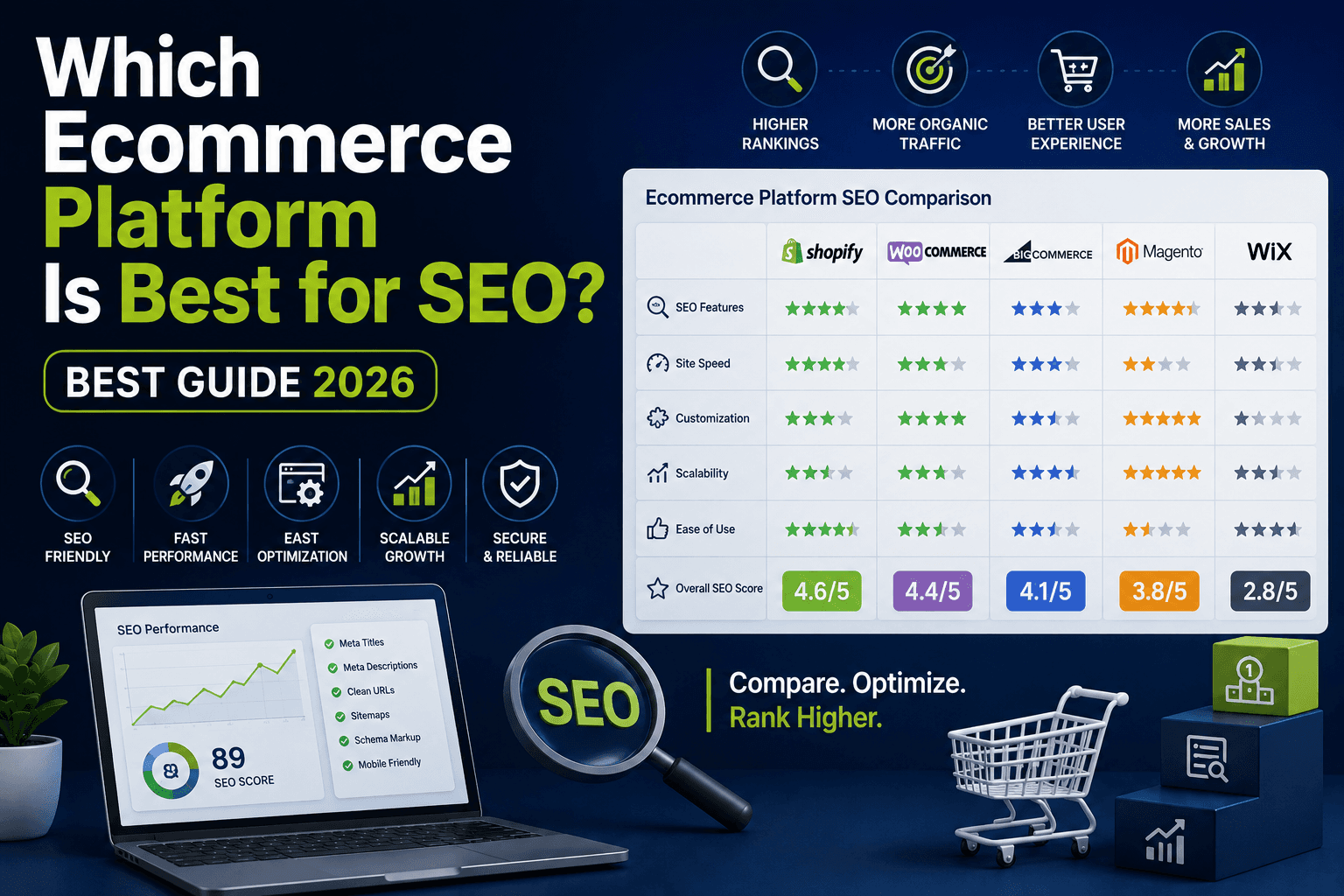
For content-first businesses where organic search is the primary channel, WooCommerce on WordPress offers the most SEO flexibility, particularly for URL structure, content management, and on-page control via Yoast or Rank Math. BigCommerce has strong built-in structured data generation. Shopify performs well for most stores but has some URL structure limitations that require careful redirect management during migrations.
Does BigCommerce charge transaction fees in Australia?
No. BigCommerce does not charge platform transaction fees on any plan tier. You pay only your payment gateway's standard processing rates. This is a meaningful cost advantage compared to Shopify for stores not using Shopify Payments.
Can I switch platforms later?
Yes, but platform migrations carry real risk to your organic rankings and search visibility if not handled correctly. URL changes without comprehensive redirect mapping, product feed disruptions, and structured data inconsistencies during migration are common causes of ranking drops. If you are considering a migration, work with an agency that has done it before.
Ready to Build or Migrate Your eCommerce Store?
TDA builds and optimises Shopify and WooCommerce stores for Australian eCommerce brands. Whether you are launching a new store, improving the performance of an existing one, or evaluating a platform migration, we can help you make the right decision for your business, not just the most popular one.
Explore our Shopify development services or get in touch to discuss your eCommerce strategy.